In this article
Motorsport Journalism Career and Goals
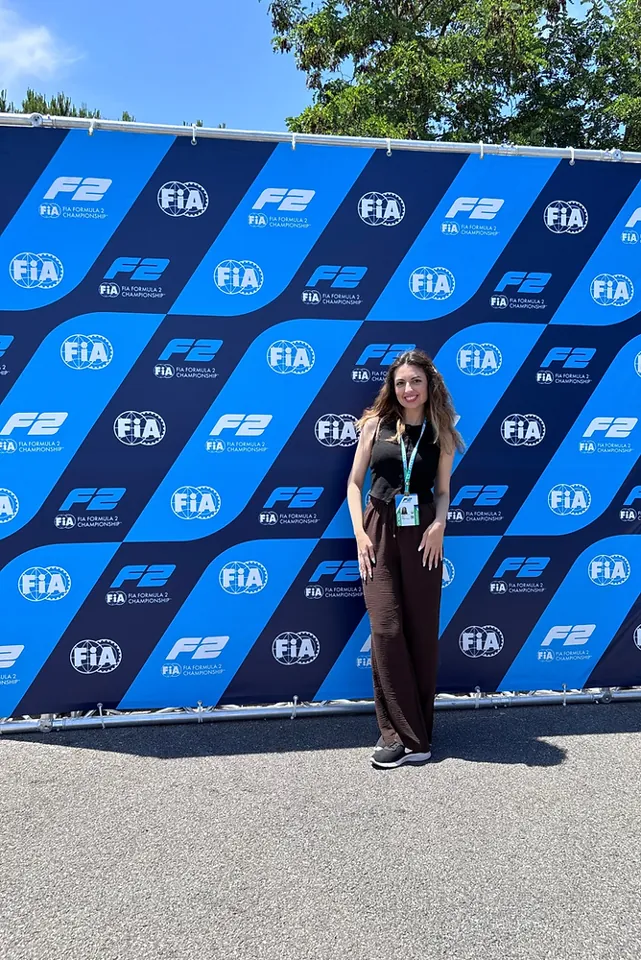
FIA-accredited sports journalist Zsofi Bertha is working to build a career in motorsport across writing, communications, and digital media. Writing for Sportime Magazin in both print and digital formats, she produces sports and lifestyle articles, news stories, race reports, and interviews, alongside recent collaborative work with Padel Magazine. Bertha's on-site accreditation experience encompasses covering Formula 2 and Formula 3 at the 2025 Hungarian Grand Prix and the 2026 Barcelona Grand Prix, followed by reporting on Formula 1 at the 2026 Hungarian Grand Prix. Looking ahead, her long-term goal is to join a Formula 1, Formula 2, or Formula 3 communications team full-time while continuing to explore freelance motorsport journalism opportunities.
Editorial Process and Feature Work
Speaking to Females in Motorsport, Bertha explained her operational approach to Grand Prix weekends, which begins by identifying interview subjects and developing concepts for feature articles. Her standard routine involves producing daily race reports on track events and aiming to complete at least two interviews each day. Once she establishes her ideas, she submits them to her editor-in-chief for review and starts preparing questions once approved. Bertha singled out the Barcelona race weekend as likely her best work yet, noting that the event produced two feature articles: an interview with Nikola Tsolov and a piece examining drivers with Formula 1 heritage, including Sebastián Montoya, Brando Badoer, Emmo Fittipaldi Jr., and Fernando Barrichello.
Related posts
Paddock Interview Pressures and Experience
With many journalists covering the same race and interviewing the same drivers, coming up with questions that stand out can be difficult, while finding a different angle and asking questions that go beyond usual race-related topics makes an interview unique. Bertha noted that when she has feature ideas, she can prepare her questions in advance, whereas when asking drivers about their races, she has to come up with questions on the spot. Because drivers must head to debriefs once track action concludes, reporters sometimes have only ten minutes to prepare and conduct the interview. She explained that managing this environment requires experience, noting that covering at least 18 sessions across three race weekends helps reporters improve, think quickly, and pay close attention to targeted drivers while watching the races.
Media Centre Realities and Trackside Demands
Working in the media centre brings its own challenges, where journalists often have to follow multiple screens without commentary, keep track of timings, and watch the race closely while preparing questions. Interviews also demand quick thinking because one answer can lead to an entirely different question, making it far from easy to find a unique angle with many reporters covering the same sessions. Bertha noted that being unable to hear commentary at the track is one of the biggest differences, making following everything more difficult than working from home, where race reports can be written while watching television broadcasts. At the circuit, she usually prefers watching from a specific corner to see the action in real life while following the race on her phone, later reviewing footage to make sure she has caught everything, with little time available because the article must be published that same day. Trackside reporting nonetheless offers the opportunity to speak with drivers post-race—an experience unavailable from home—and in Formula 2 and Formula 3, Bertha tries to gather as many quotes as possible, ask questions, and incorporate driver insights into her stories. Behind every published race report lies substantial unseen effort, from locating drivers before they leave for subsequent commitments to meeting impending deadlines, requiring patience, hard work, and readiness for the unexpected.