At a glance
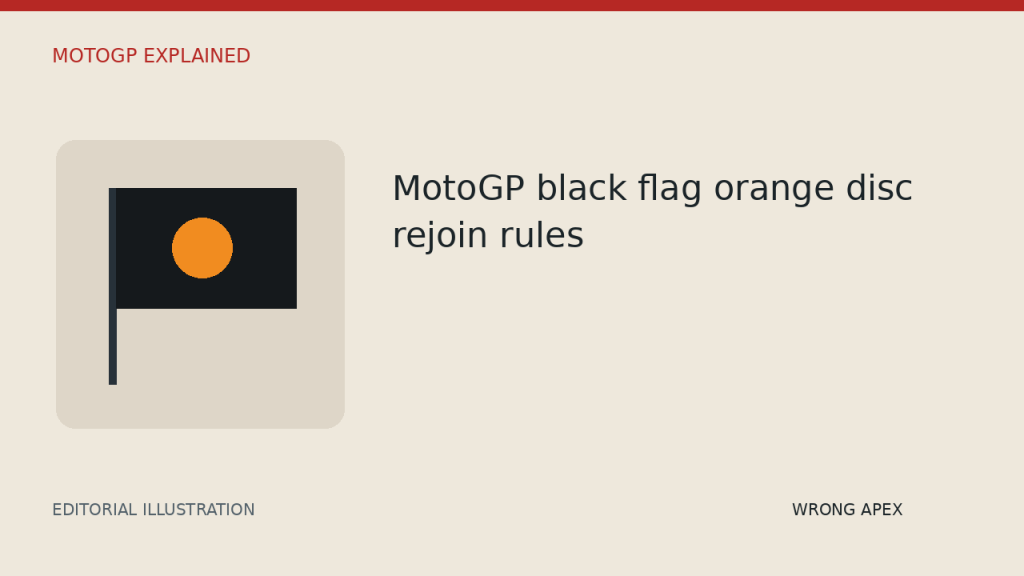
- A MotoGP rider shown the black flag with an orange disc must leave the track immediately. Rejoining requires an official’s authorisation.
- The signal identifies one rider whose motorcycle has mechanical problems likely to endanger themselves or others. Officials display it with the rider’s number.
- A plain black flag resulting from a penalty requires stopping at the pits at the end of the current lap and prohibits restarting. It also has non-penalty uses.
MotoGP riders shown the black flag with an orange disc may rejoin only with an official’s authorisation, after leaving the track immediately. The 2026 FIM Grand Prix World Championship Regulations, updated 13 September 2026, set out that response; the signal does not automatically end their participation.
Leaving the track and obtaining permission to return
The orange disc signals mechanical problems likely to endanger the rider or others. Its immediate-exit instruction differs from the procedure for a plain black flag resulting from a penalty, which requires the rider to stop at the pits at the end of the current lap.
Completing repairs does not, by itself, authorise a rider to rejoin: an official must give permission.
What viewers should look for
Look for the orange disc against the black background and the accompanying rider number. Officials wave or display the signal at each signalling post, identifying the individual rider who must respond. The official MotoGP guide to flag meanings also covers this signal alongside the championship’s other flags.
Light panels can accompany or replace flags under the FIM regulations. Both flags and track lights are official signals, and technical constraints can mean a panel’s appearance differs slightly from the physical flag. The instruction therefore does not depend solely on a rider seeing a waved flag.
Related posts
MotoGP Rules & Flags
MotoGP red flag restart rules: laps, grids and points explained
MotoGP Rules & Flags
MotoGP Yellow Flag Overtaking Rules: When Passing Is Banned
Why a plain black flag needs context
The required response depends on both the signal and the reason officials have shown it:
| Signal and context | Required response | Return or restart condition |
|---|---|---|
| Black flag with an orange disc | Leave the track immediately because of mechanical problems likely to endanger the rider or others | Rejoining requires an official’s authorisation |
| Plain black flag resulting from a penalty | Stop at the pits at the end of the current lap | The rider cannot restart under that penalty instruction |
Source: FIM’s 2026 Grand Prix regulations, updated 13 September 2026.
The plain black flag can also convey an instruction unrelated to a penalty. The FIM gives rectifying a non-dangerous technical problem, such as a transponder problem, as one example. That differs from the mechanical danger identified by the orange disc.
Another non-penalty use concerns a rider on the warm-up lap who reaches pit-lane entry after the safety car. In that situation, the plain black flag instructs the rider to enter the pit lane.
Image credit: Wrong Apex editorial graphics · Original editorial illustration · Modifications: Rendered from original graphic elements; resized and compressed to WebP. · Image source