In this article
Ferrari's Active Rear Wing Emergence in Testing
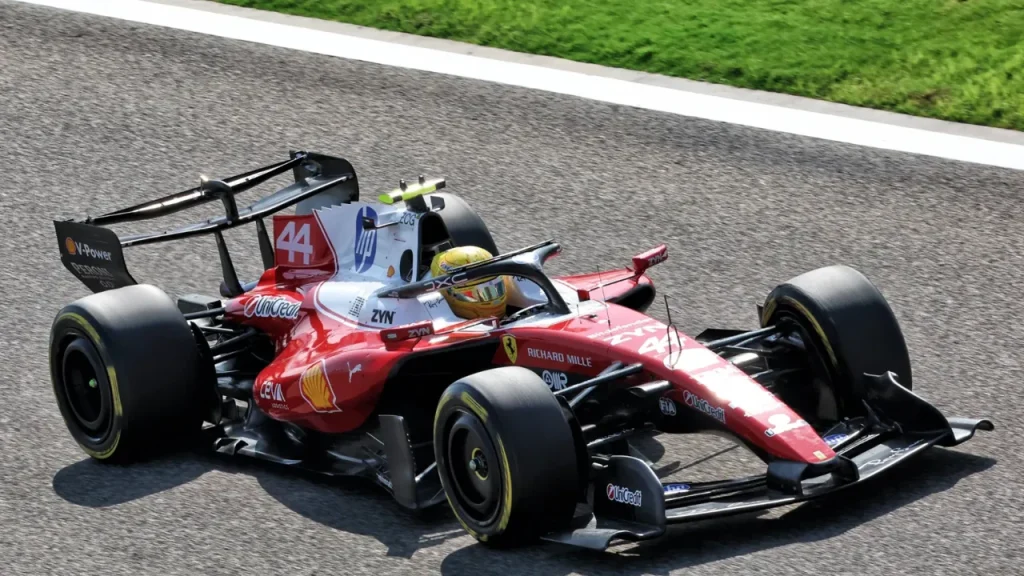
Ferrari unveiled an unconventional rear wing configuration during pre-season testing at the Bahrain International Circuit on the second day of week two. Driven by Lewis Hamilton, the car showcased a pivoting mechanism that moved dynamically as the vehicle transitioned into and out of designated active aero zones. The scarlet machine behaved unlike any of the other ten competing cars, instantly capturing widespread paddock attention.
The assembly exhibited an unfamiliar range of motion that surprised rival pit personnel and sparked immediate curiosity across the pit lane. Instead of maintaining a fixed geometry, the components shifted during track running, distinguishing Ferrari's aerodynamic pathway from standard contemporary designs.
Garage Secrecy and Early Track Validation
Hamilton completed five exploratory laps during that initial Bahrain outing, registering a single full push lap before returning to the pit lane. Immediately upon the car's arrival, Ferrari personnel formed a defensive wall in front of the garage entrance to shield the vehicle from view, swiftly removing the experimental wing and concealing it inside.
Following that secluded test, the component was omitted from the opening round in Melbourne while team officials remained silent about its development status. Hamilton subsequently confirmed that the apparatus—now colloquially termed the Macarena wing—would officially appear at the Chinese Grand Prix in Shanghai, stating that the five-lap Bahrain cameo had supplied sufficient baseline operational validation.
Rob Smedley on Innovation Versus Visual Drama
Former Ferrari race engineer Rob Smedley highlighted the technical daring behind the concept, praising the team's willingness to embrace lateral problem-solving. Smedley drew parallels to engineering developments like Mercedes exploring compression ratios, noting that innovative concepts prompt rival designers to question why they failed to conceptualize the idea first.
However, Smedley cautioned against overestimating the immediate lap-time impact based solely on dramatic visual kinematics. Observers outside racing teams often assume that radical physical movements correlate with massive performance gains, whereas car performance gains usually stem from modest, incremental improvements that accumulate across the entire chassis package.
Related posts
Aerodynamic Trade-Offs and Track Reality
Smedley noted that every engineering innovation involves a compromise and a trade-off between competing vehicle behaviors. The wing's practical efficacy depends on navigating the fundamental aerodynamic trade-off between downforce and drag under varying circuit demands across the racing calendar.
Despite these aerodynamic compromises, Smedley praised Ferrari for executing bold creative innovation. The Italian squad chose to explore novel aerodynamic territory rather than passively converging on identical design solutions seen across rival garages, demonstrating the value of lateral engineering thought in modern car design.
The Flow Turning Device and Diffuser Integration
The structural cornerstone of Ferrari's concept is a specialized flow turning device positioned at the bottom of the main wing assembly with an aggressive upward inclination. This aerodynamic element serves a dual function: it channels exhaust gases upward toward the rear wing while simultaneously conditioning delicate airflow emerging from the underbody diffuser.
This interaction is engineered to operate alongside an extended rear diffuser. Competing teams have searched aggressively for supplemental downforce following the sport's transition away from ground-effect cars, and Ferrari's elongated floor effectively stretches the airflow path to harvest additional aerodynamic load directly from the car's trailing bodywork.
Differential Placement and Transmission Packaging
Locating the diffuser significantly further rearward than rival designs required radical mechanical packaging within the car's rear driveline. Ferrari engineered a bespoke differential and angled the driveshafts, allowing the aerodynamic floor surfaces to extend much further back without encountering obstructive packaging constraints from standard transmission layouts.
Angling the driveshafts introduces severe mechanical vulnerability, because inclined rotating shafts can induce damaging vibrations that lead to component failure. Such risks are evident elsewhere on the grid, where Aston Martin suffered violent engine vibrations that shook machinery apart. Consequently, Ferrari engineered robust linkages to withstand these stresses, establishing a proprietary configuration that rivals cannot copy without undertaking a fundamental redesign of their entire transmission system.
Echoes of Blown Diffuser Aerodynamics
Ferrari's arrangement echoes the exhaust-blown aerodynamic philosophies popularized during the sport's V8 engine era in the early 2010s. During that period, high-revving naturally aspirated engines directed hot exhaust gases directly across the rear diffuser surfaces, energizing boundary layers and creating downforce alongside a characteristic acoustic screech under throttle.
On the SF-26, however, Ferrari diverts those thermal energy streams beyond the diffuser alone, directing exhaust gas onto the lower plane of the rear wing assembly. Energizing the lower wing profile in this manner provides a substantial boost to total rear downforce, demonstrating how historical aerodynamic concepts can be repurposed within modern vehicle architectures.
Dual-Mode Operation and Inverted Wing Kinematics
To optimize performance across diverse track conditions, the wing shifts between distinct aerodynamic states. In normal cornering mode, the upper element presents a smaller surface area where balanced air pressure applies across both upper and lower surfaces, generating stable aerodynamic downforce for the SF-26.
When switched into straight-line active aero mode—dubbed Macarena mode—the wing rotates completely upside down. This motion opens an exceptionally large slot gap compared to rival cars, while staying fully compliant with governing technical regulations. Because the inverted element possesses a smaller surface area, it creates greater open passage than conventional flap profiles, drastically reducing drag down long straights before Lewis Hamilton and Charles Leclerc conduct race-weekend evaluations during Chinese Grand Prix practice sessions.
Sources: Tech: The unique Ferrari ‘Macarena’ F1 rear wing explained.