In this article
Replacing Classic Straight Sixes in Club Racing
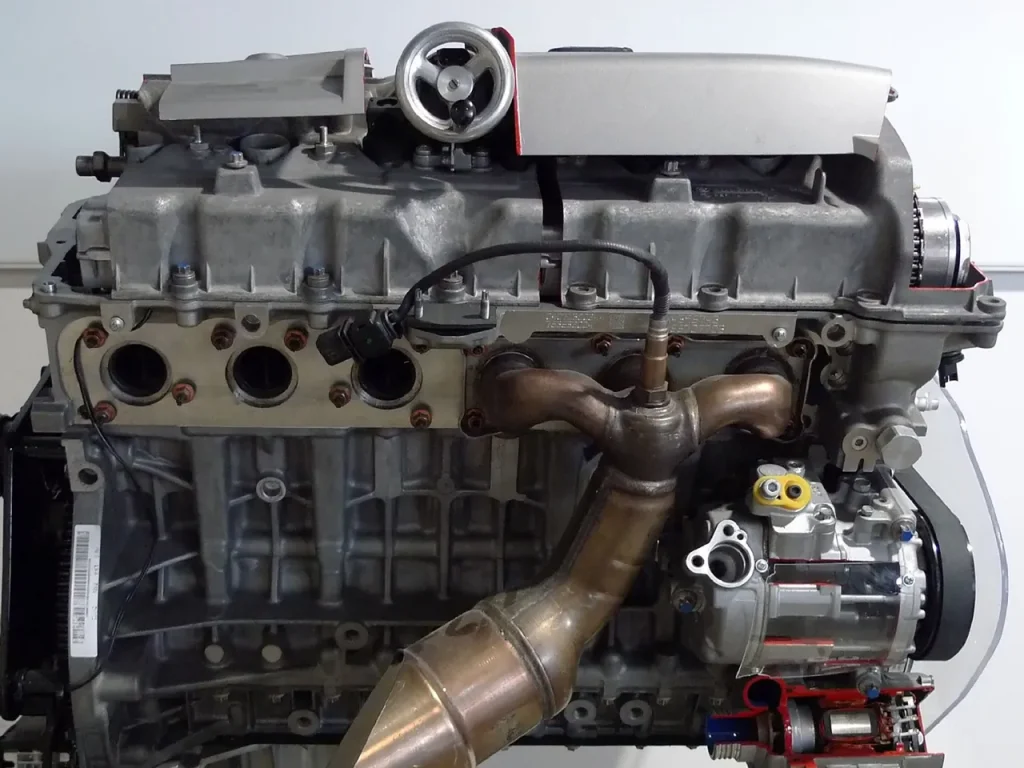
Club racers relying on BMW inline-six power face a dwindling supply of older M5x and S5x engines compared to fifteen years ago. Spec E46 competition absorbed many surviving M54 engines, leaving spare chassis without affordable powerplants. Sacramento builder Justin Ross of Magic Developed evaluated the naturally aspirated N52 after encountering it during daily street maintenance.
Observing intake port dimensions during routine starter replacements suggested the powerplant could produce significantly more than its factory rating of 225 horsepower. Ross also recalled seeing Nürburgring endurance cars successfully run the N52 in their own spec class for years, hinting at reliable competition potential.
Chassis Fitment and Drivetrain Integration
Sourcing an N52 remains accessible, with low-mileage examples costing between $1,200 and $1,700. When installed into an E46 chassis using Z4 engine mounts, the block drops directly into position. It mates to the GS6-37 six-speed manual transmission found in the E90 330i and Z4 3.0si. Builders retain most original E46 chassis ancillaries.
Plumbing the engine requires adapting its components to the E46 chassis. Magic Developed fitted custom hoses to connect the N52 power steering pump to the E46 steering rack. The team also fabricated an upper radiator hose to mate with the radiator and a lower hose linking to the N52 electric water pump.
Maintenance Peculiarities and Installation Costs
Operating an N52 involves specific chemical and block constraints. Its magnesium-aluminum alloy block requires careful cleaning with solvent rather than acid, and builders must prevent water from pooling. In addition, earlier engine blocks feature alusil cylinder liners that can corrode if not monitored closely.
Assembly also demands single-use torque-to-yield aluminum bolts, with necessary hardware and gaskets totaling roughly $400 for the swap. Furthermore, the external electric water pump is an unavoidable wear item. Costing nearly $400, the electric pump wears out at 60,000 miles without exception.
Lubrication and Crankcase Breather Solutions
Crankcase ventilation poses an immediate challenge during track use, because the N52 evacuates oil through its PCV system. Racer Smith resolved heavy oil spray by installing a pipe routing the PCV to the rear of the car. Before this modification, oil loss required adding a quart every three hours as lubricant sprayed across the engine bay and into the cabin.
Lubrication under racing loads also required intervention. Smith initially tested an F8x S55 oil pump, but found poor fitment and persistent oil pressure drops under heavy braking and left-hand turns. Ross fabricated a custom baffled pan to control fluid movement, while Smith mounted an Accusump in the passenger footwell and added an extra quart of oil.
Related posts
Engines & Power Units
Formula 1 and Road Relevance: Why the Hybrid Power Unit Created a Conflict
Engines & Power Units
ECU Wiring Basics and Sensor Selection for Race Car EFI Systems
Engine Management and Thermal Durability
Engine management relies on a standalone MaxxECU to integrate the modern engine with the older chassis. The unit provides advanced CAN-bus protocol control and protective fail-safes that shield the engine under severe stress. Ross noted that these safeguards allowed pushing the engine to operational limits that would have caused an older S54 to fail.
The N52 demonstrated impressive thermal endurance during competition. After radiator damage at Circuit of the Americas, the engine ran for three hours with coolant temperatures exceeding 240 degrees Fahrenheit. At the Utah six-hour enduro, oil temperatures reached 305 degrees during a winning run, and an accidental 8,900 RPM over-rev survived another six months of use.
Normal track operation uses the stock radiator and integrated oil cooler. Because BMW placed the coolant temperature sensor at the coolant outlet rather than on the cold side, readings register higher than on earlier engines. Ross aims for coolant temperatures between 210 and 220 degrees Fahrenheit, while oil typically runs at 270 degrees Fahrenheit.
Weight Distribution Versus Turbocharged Alternatives
Smith previously experimented with a direct-injection turbocharged four-cylinder in his E46, choosing an aluminum, open-deck N20 mated to a six-speed transmission. At the time, the N20 was the lightest engine meeting his criteria, aligning with his emphasis on building a lightweight car that was nice to its tyres. However, the four-cylinder suffered engine failures on 93-octane fuel and required expensive 100-octane fuel.
The N20 also lacked efficiency without a sequential gearbox to keep it inside its narrow powerband. Adding a couple of cylinders to the front of the car did not influence the handling much, according to Smith. The magnesium-aluminum block sheds roughly 45 pounds compared to an M54 and 110 pounds under an S54, with observers from E46 M3s noting that it turns in well.
Intake Tuning and Valvetronic Adjustments
Extracting competitive horsepower from the N52 requires relatively few modifications. Bolting on a single-stage intake manifold and throttle body from an N54 alongside an aftermarket exhaust manifold produces a proven 250 to 260 wheel horsepower. Racers can also install Modified Intake Lift Valvetronic hardware, which alters the infinitely variable valvetrain to increase intake valve lift and boost top-end power.
For NASA ST4 competition, Smith opted for a different tuning strategy. While the N54 manifold favored peak revs at the expense of low-end response, he chose the three-stage intake from an E90 330i. This configuration yielded 230 to 240 horsepower across a broader powerband, enabling short-shifting with Maxxis tyres to maintain low weight and improve fuel economy.
Endurance Efficiency and Operating Economy
Operating efficiency makes the N52 particularly attractive for endurance racing. During the Sunchaser six-hour race, Smith reported fuel consumption dropping to as little as ten gallons per hour when aided by yellow flags. Lower fuel burn extends stint lengths and reduces necessary pit stops, reinforcing the strategic advantages of running a naturally aspirated six-cylinder package in club competition.
The conversion provided dependable competition without the financial hazards of high-strung M-division powerplants. With affordable low-mileage replacement blocks and robust factory transmissions, the N52 avoids impending big-ticket failures. Munich's final atmospheric inline-six demonstrates that competitive pace and endurance reliability in club sports car racing do not require exorbitant budgets.
For the electronics side of a racing-engine installation, see ECU wiring basics and sensor selection.
Sources: Why the N52 Might Be BMW Racing's Best Kept Secret – NASA Speed News Magazine.