

At a glance
- NASCAR calculates a car’s average speed within each timing segment, using the distance between embedded loops and the time taken to cross it.
- Each segment is checked separately. A slow pit stop does not cancel speeding elsewhere on pit road.
- Acceleration, braking and time spent stationary affect the average within the segment where they occur.
In this article
NASCAR measures pit road speeding by timing cars between fixed scoring loops in the pavement. Divide the known distance by the elapsed time and the result is the car’s average speed for that stretch. A speeding call therefore concerns a timed segment, rather than a radar reading at one particular point.
How the timing lines identify and measure a car
Each car carries a unique transponder. When it crosses a scoring loop, the system registers its passage and identifies the car. Those successive detections provide the elapsed time needed for the calculation, as Building Speed’s technical explanation describes.
The calculation is straightforward: average speed = segment distance ÷ elapsed time. For a fixed distance, crossing the next loop sooner produces a higher calculated speed. The system does not need to establish exactly how the driver used the throttle or brakes between those detections.
Crucially, the measurement is repeated along pit road. Happy Hour Racing’s July 2026 explainer describes several timed segments, with a car potentially complying in one and speeding in the next. Averaging the entire journey from pit entry to pit exit would miss that distinction.
Why drivers can accelerate without triggering a call
A segment average can include both faster and slower running. A brief burst above the applicable threshold does not by itself establish a speeding violation if the average for that segment remains within it. Conversely, braking before the next line does not guarantee compliance: the elapsed time across the whole segment still determines the result.
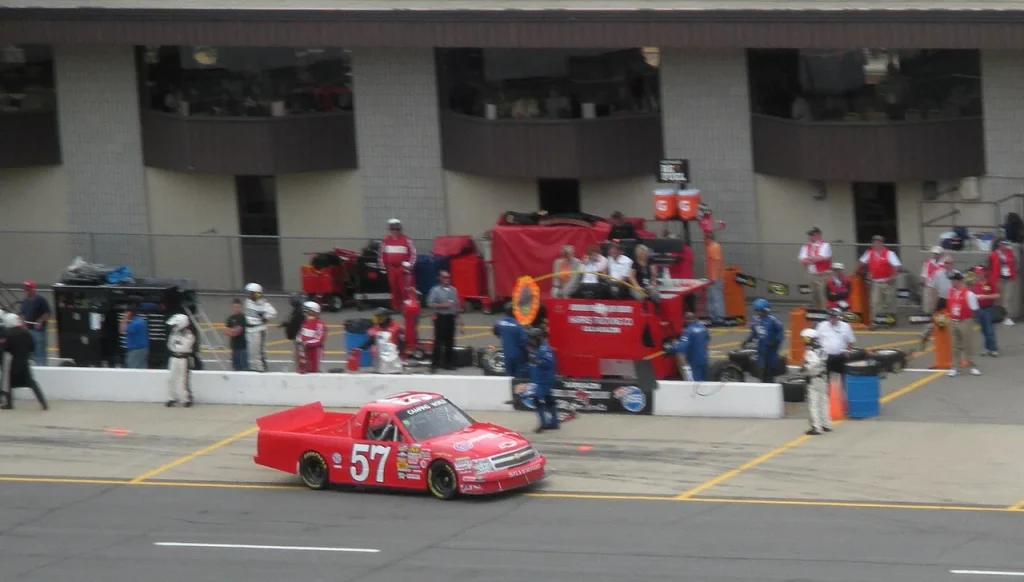
A pit stop makes this especially visible. If the car stops between two timing loops, its stationary time counts toward that segment’s elapsed time, lowering the average. That can leave room for stronger acceleration as the driver leaves the box. Once the car crosses into the next segment, however, that earlier stationary time is outside the new measurement.
Why timing-line placement matters
Teams can obtain maps showing the timing-line locations. Building Speed explains that the relationship between pit boxes and timing lines has given some stalls an advantage, prompting NASCAR to add lines on many pit roads. The relevant detail is which segment contains the stop and where the next measurement begins.
Short segments also give drivers less room for error. A brief application of too much throttle occupies a larger share of a short segment’s travel time, so it can have a greater effect on the average. Knowing the line locations helps drivers judge where acceleration will affect the next reading.
The posted limit and the enforcement threshold
Happy Hour Racing describes the tolerance above the posted limit as commonly around 5 mph. That distinction matters when interpreting a report that a driver exceeded the limit by a fraction: the posted number and the effective enforcement threshold are different reference points.
Drivers use engine RPM on the tachometer to judge road speed, but that remains an instantaneous reference. It does not display the average NASCAR calculates between loops. Managing that average requires attention to both the car’s speed and its position within the timing segment.
Related reading: F1 pit stop time vs pit-lane time: what each measures.
Image credit: Illustrative photograph. · mr_t_77 · Modifications: Wikimedia-provided thumbnail. · Image source · CC BY-SA 2.0