At a glance
- Stationary stop time measures the service while the car is stopped.
- Recorded pit-lane duration includes travel through the timing interval as well as service.
- Net pit loss compares the stopping car with the time it would have taken to stay on track.
Three timings that answer different questions
A two-second tyre change does not mean the car loses only two seconds against a rival who stays out. Braking, pit-lane travel, service, exit and tyre preparation all affect the comparison. Calling each of those measures “pit-stop time” hides the distinction.
| Measure | What it describes | What it cannot establish alone |
|---|---|---|
| Stationary service | Work while the car is stopped | Total time lost to an on-track rival |
| Recorded pit-lane visit | The published timing-loop interval | A tyre-change-only crew time |
| Net pit loss | Difference against a defined stay-out baseline | A permanent circuit constant |
An official timing example
The 2024 Azerbaijan pit-stop summary lists Piastri’s lap-15 visit at 20.181 seconds and Leclerc’s lap-16 visit at 20.671. Those are recorded visit durations. They are not 20-second stationary tyre changes, nor do they prove Piastri gained exactly 0.490 seconds in the complete strategy exchange.
Related posts
Strategy & Pit Stops
Pit-Lane Visits by F1 Race Winners: 2014–2024 Data
Strategy & Pit Stops
Leclerc’s One-Stop Strategy Beat McLaren at Monza in 2024
For a service-speed benchmark, the 2023 DHL award table lists McLaren’s Qatar stop at 1.80 seconds. Different timing definitions explain why the numbers are so far apart. Our award explainer describes that winners-only sample.
Estimating net loss
A simple two-lap estimate subtracts two comparable uninterrupted laps from the combined in-lap and out-lap time. The pit transit is already contained in those laps: adding it again would double-count it.
That estimate needs matched conditions. Tyre warm-up, fuel, traffic, a changing track or a neutralization can make the baseline unsuitable. A race engineer’s estimate should state which laps and conditions it uses, rather than call the result the exact “true” loss.
An illustrative 20-second net loss, offset by a constant 1.0 second per lap of additional pace, takes 20 usable laps to recover. It is arithmetic, not a claim that every circuit costs 20 seconds. See our extra-stop calculation.
Safety Cars and tyre rules
Under a Safety Car or VSC, the on-track comparison changes, so pitting can cost less relative time. There is no universal percentage reduction that turns every caution into the same cheap stop.
The dry-race requirement concerns tyre specifications. A permitted tyre change during a red flag can satisfy that requirement without a normal green-flag stop. See the dated Monaco example in our tyre guide.
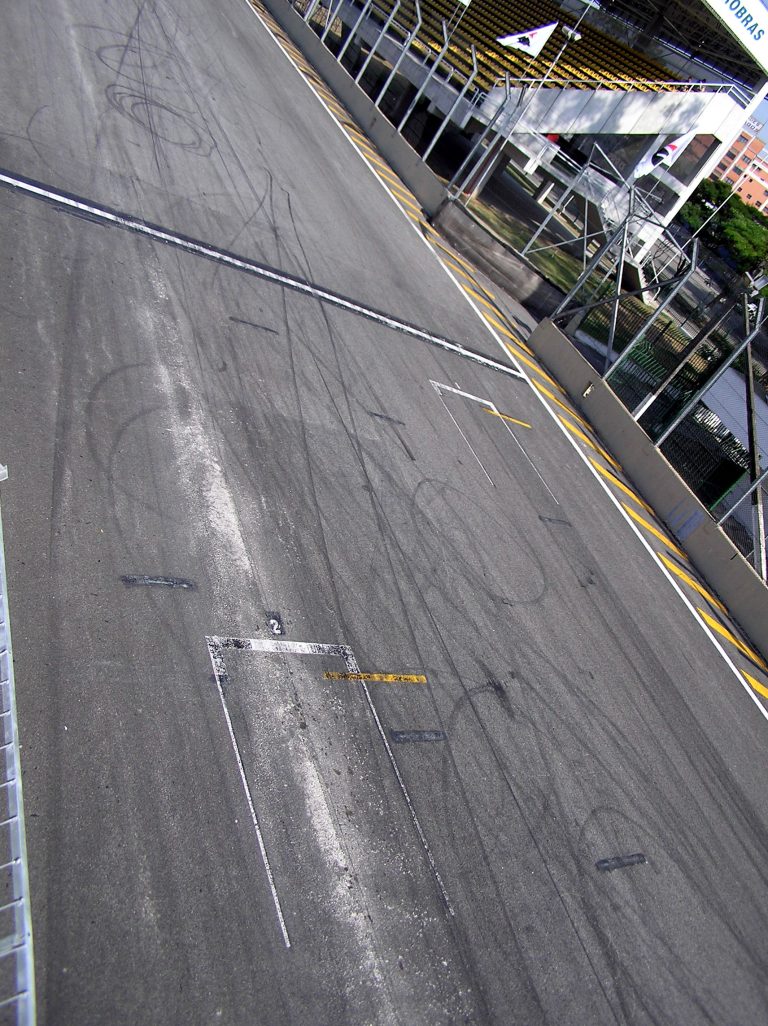
Image credit: Representative image; not a photograph of the reported event. · Alberto-g-rovi · Own work · Modifications: None; Wikimedia thumbnail size · Image source · CC BY-SA 4.0