At a glance
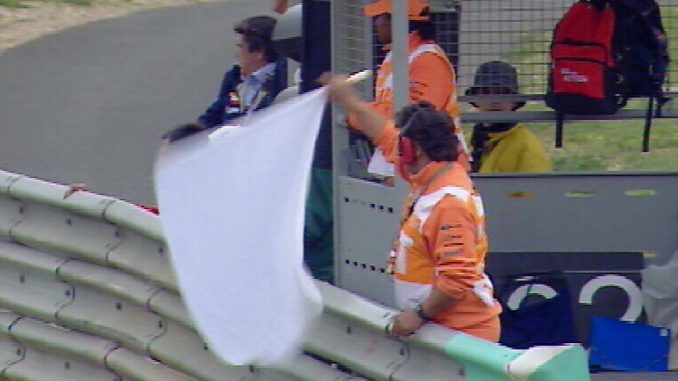
- MotoGP’s plain white flag allows riders to change motorcycles; it does not require an immediate change.
- A white flag with a red diagonal cross warns of rain. That signal alone is not the bike-change authorization.
- Permission to change bikes does not override a red flag, pit-lane closure or other Race Direction instruction.
Does a white flag make a bike change mandatory?
No. A MotoGP rider may stay out after the plain white flag if they judge that appropriate. The signal tells riders that Race Direction has authorized machine changes and flag-to-flag rules apply.
The distinction is practical. A rider on slicks might wait while rain remains light; another might change earlier. The flag gives them that choice rather than ordering everyone into the pits together. It does not certify that slicks remain safe everywhere.
White flag or rain warning?
MotoGP’s official flag guide distinguishes the plain white flag from the white flag with a diagonal red cross. The latter reports rain in that section of track, including rain affecting the surface.
A rain warning does not, by itself, establish whether bike changes have been authorized. Nor does it cancel an authorization already in force. Riders need to read the signals together with the race’s declared status.
Related posts
Strategy & Pit Stops
F1 Pit Stop Time vs Pit-Lane Time: What Each Measures
Strategy & Pit Stops
IndyCar Caution Rules: How Emergency Service Operates When Pits Are Closed
The important distinction is permission versus obligation, rather than calling the plain white flag a harmless advisory. Race Direction controls when machine changes are allowed.
How flag-to-flag changes work
In MotoGP’s official explanation with Race Director Mike Webb, the rider can switch to the spare machine once flag-to-flag conditions apply. The explanation permits repeated changes and does not require the replacement bike to have a different tyre type. Moto2 and Moto3 do not use this premier-class two-bike procedure.
Pit-lane safety still applies. The explanation specifies a 60 km/h limit and a standard double Long Lap Penalty for exceeding it during a race, with different or additional sanctions possible for dangerous conduct. A permitted swap is not permission to rush through the lane above its limit.
A white flag does not guarantee uninterrupted racing
Race Direction can still interrupt a race. A red flag requires a careful return to pit lane; a closed pit exit must be obeyed. Flag-to-flag rules provide an option for changing conditions, not a promise that every wet race will continue.
For a comparison with car-racing signals, see our F1 flag guide. Flag meanings depend on the championship: matching colours do not guarantee matching instructions.
Image credit: Representative image; not a photograph of the reported event. · Modifications: None; original downloaded file · Image source