At a glance
- Multiple pit-lane starters line up according to the applicable grid-order procedure, rather than racing to reach the exit first.
- A car reaching pit exit after the five-minute signal goes behind cars already there.
- Release depends on the start procedure, the passing field, pit-exit signals and officials’ directions.
How the pit-lane queue is ordered
The 2026 FIA Sporting Regulations, Section B, Issue 09, Article B5.3.2, refer race pit-lane starters to the ordering procedure in B2.5.4. Sprint starters use the separate Sprint provision. The late-arrival exception applies after the five-minute signal, not only after the formation lap.
The grid procedure includes qualifying classification, accumulated unserved grid penalties and rules for filling vacant positions. For classified drivers with at most 15 places of applicable penalties, it first assigns temporary positions from qualifying rank plus penalties. It then resolves ties and fills gaps. Drivers with more than 15 places have a separate ordering step. This is more precise than simply sorting everyone’s raw lap time or adding a penalty to the final grid number.
For a particular race, the published grid and stewards’ instructions are the practical reference. A no-time qualifying classification also needs the activity-group hierarchy.
Why a car starts from the pits
Formula 1’s official pit-lane-start explainer describes circumstances such as setup changes under parc fermé and a car not ready for its grid position. A component grid penalty does not automatically require a pit-lane start: those are different consequences.
Related posts

Some repairs and adjustments are permitted under specific conditions, so a repair does not automatically mean a parc fermé breach. Power-unit component allocations also depend on the season; the 2026 architecture no longer includes an MGU-H.
Formation lap and release
Reconnaissance laps, the formation lap and the race start are separate procedures. Missing the window for reaching the grid does not mean the same thing as failing to join a formation lap. The regulations and event instructions determine which procedure applies to a pit-lane starter.
At the race start the queue must wait for release; a driver cannot choose to enter ahead of the passing field. Follow the pit-exit light and officials, including any modified procedure for weather or a delayed start.
Starting from pit lane can permit a different setup, but it also concedes position and time. It does not guarantee clean air or a successful recovery. Our pit-lane timing guide explains why the race-time cost differs from stationary service time.
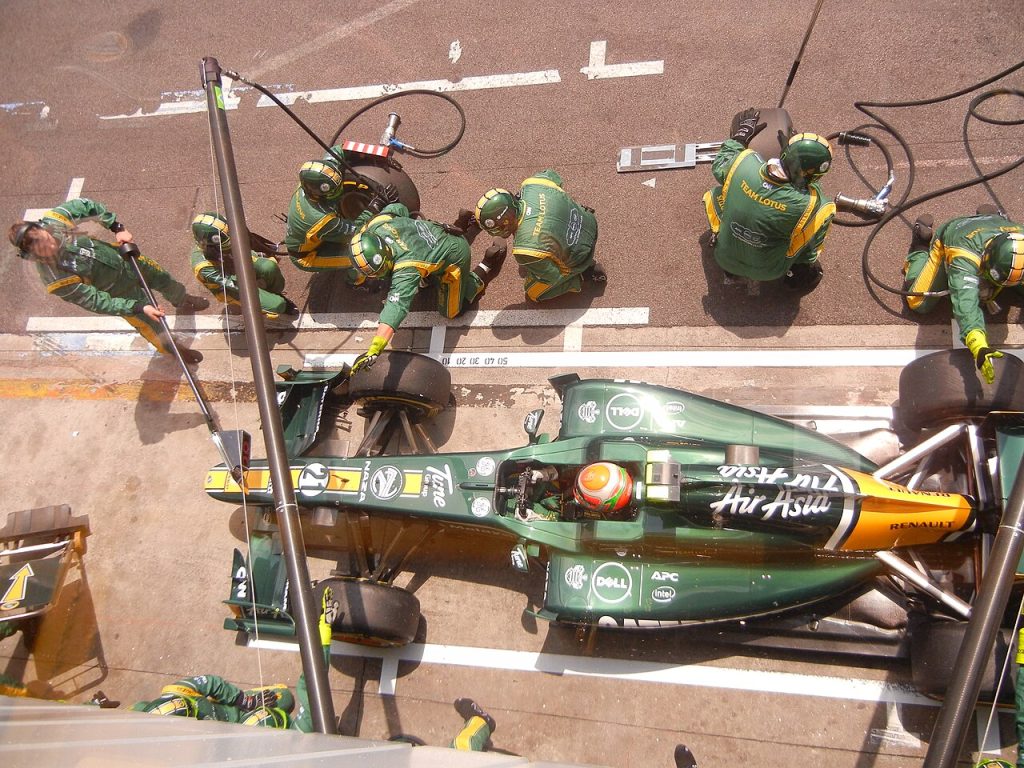
Image credit: Representative image; not a photograph of the reported event. · Dell Inc. · Team Lotus car in the pit lane during the race · Modifications: None; Wikimedia thumbnail size · Image source · CC BY 2.0