
In this article
Historic Milestone Handover in Munich
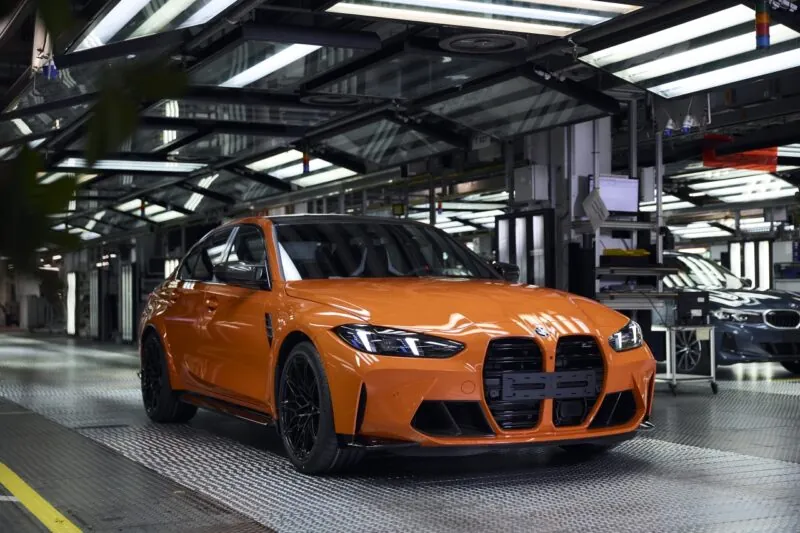
BMW has reached a significant manufacturing landmark after completing the one-millionth vehicle from its M High Performance line since the establishment of its dedicated motorsport department in 1972. The milestone car, an M3 saloon from the G80 generation finished in BMW Individual Fire Orange III, rolled off the line at the company's historic Munich plant in September 2026. Peter Weber, director of the Munich facility, handed the keys to BMW M chief executive Franciscus van Meel. According to van Meel, BMW M combines road and track capability with everyday usability, adding that the millionth BMW M vehicle demonstrates that these values remain just as appreciated by customers 40 years after the commercial launch of the first BMW M3.
Homologation Roots and the Alpina Connection
BMW M originally commenced road car operations during its inaugural year in 1972 with the 3.0 CSL, a model based on the E9 coupe developed specifically for racing homologation in collaboration with Alpina, which operated as an independent specialist tuner at the time before BMW later acquired the brand in 2022. Motorsport-led road development continued four years later when BMW's South African subsidiary commissioned the division to develop a high-performance road-going derivative of the E12 5 Series for competition homologation, yielding the limited-production 530 MLE (Motorsport Limited Edition). In 1977, the manufacturer broadened availability by offering Motorsport upgrade packages for the 525 and 528.
Related posts
Iconic Cars
McLaren MP4/4 Record: 15 Wins in 1988
From the M1 Supercar to the First M3
The division introduced its first standalone vehicle in 1978 with the mid-rear-engined M1 supercar, an original design developed by BMW M from the 1972 Turbo concept for both racing and road use that firmly established the M badge's reputation. Volume manufacturing expanded in 1979 through the introduction of the first-generation 5 Series-based M535i. BMW M escalated its saloon programme in 1984 by releasing the E28-generation M5, which was powered by an adapted version of the M1's M88 inline-six engine. The first-generation M3 followed two years later in 1986, reaching its 40th anniversary in 2026.
Lineup Diversification and Global Manufacturing
Over subsequent generations, the M line expanded beyond saloons and coupes to encompass touring estates and convertibles, including the Z3 M, M6, Z4 M, 1 Series M Coupe, M2, and M8. The portfolio eventually incorporated performance SUVs such as the X5 M, X6 M, X3 M, and X4 M, while the XM arrived in 2022 as only the second standalone M offering lacking a standard BMW counterpart. The vast majority of BMW M road vehicles have been manufactured in Germany, although SUVs are built in the United States and the M2 is assembled in Mexico, contending in the same market space as Mercedes-AMG and Audi Sport's RS division.
Munich Plant Transition and Delivery Growth
With the current G80 generation entering the closing stages of its lifecycle, BMW's Munich assembly site is scheduled to halt the production of internal combustion vehicles in 2027. However, the facility will not abandon M models, as the future electric iM3—a name still subject to confirmation—on the Neue Klasse platform will be assembled there. A new combustion-powered M3 is also in the pipeline, but would therefore be produced elsewhere. Total BMW M deliveries reached 213,457 units in 2025, marking a three percent rise over the preceding year when counting intermediate M Performance models such as the M135 and X3 M50 alongside pure M cars, among which the M2 currently stands as the best-seller.
Sources: BMW M. Un million de sportives Motorsport sont sorties d’usine.