

At a glance
- Spa-Francorchamps leads this ten-track comparison with 102.2 metres between its highest and lowest points, followed by the Red Bull Ring at 63.5 metres.
- Interlagos, Monaco and Suzuka complete the leading five.
- These figures measure the difference between a circuit’s highest and lowest points, rather than adding together every climb. The list follows Formula1.com’s published comparison, rather than claiming to cover every F1 circuit in history or the current calendar.
In this article
Spa-Francorchamps has the biggest elevation difference in Formula1.com’s circuit comparison. Its 102.2-metre range puts it comfortably ahead of Austria’s Red Bull Ring, while the remaining circuits show how different a lap can feel even with a smaller vertical span.
The ten entries below retain the descending order and measurements in that article, dated 5 September 2024. F1Blast’s October 2024 guide also selects Spa, the Red Bull Ring, Interlagos, Monaco and Suzuka as its leading five.
1. Spa-Francorchamps, Belgium — 102.2m
Spa’s defining feature is the speed with which a descent can become a climb. Eau Rouge and Raidillon provide the famous example: the circuit changes gradient sharply through the sequence. The full 102.2-metre figure, however, describes the difference across the circuit, rather than the height of that single climb.
2. Red Bull Ring, Austria — 63.5m
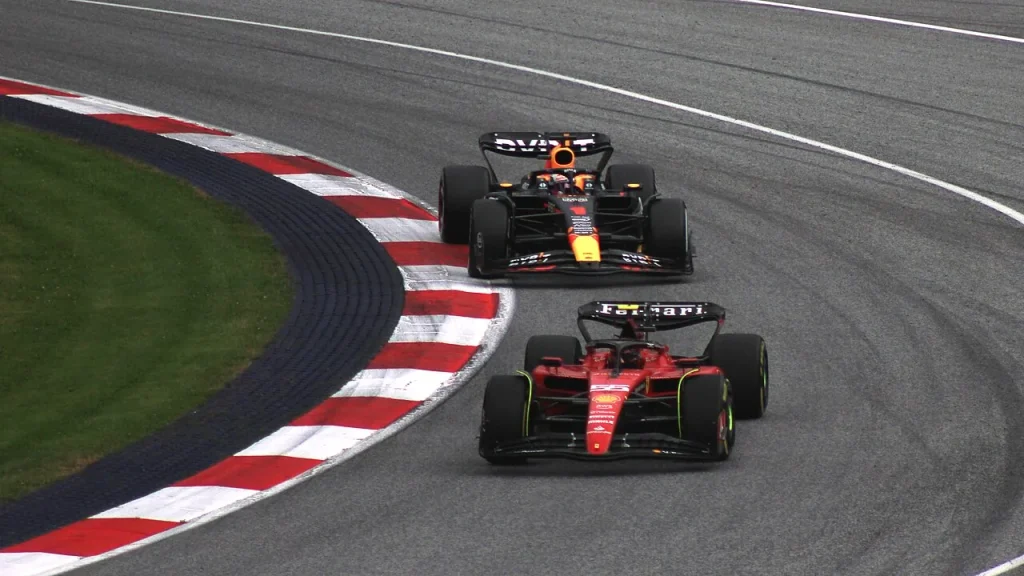
Spielberg’s lowest point lies on the start-finish straight, with the circuit climbing into the surrounding Alpine terrain. Its 63.5-metre range gives Austria a clear second place in this comparison, despite being substantially smaller than Spa’s vertical span.
3. Interlagos, Brazil — 43m
At the Autódromo José Carlos Pace, the highest point sits on the rise between the start-finish line and Turn 1. From there, the track descends towards its lowest point at Turn 5. That opening plunge helps give Interlagos its distinctive profile immediately after the lap begins.
4. Monaco — 42m
Monaco’s streets combine a compact layout with a substantial change in height. The climb from Sainte Devote towards Casino Square takes drivers to the circuit’s high point, while the lowest section comes just before La Rascasse.
5. Suzuka, Japan — 40.4m
Suzuka’s low point lies between Turns 1 and 2, reached after the descent from the final corners. That downhill approach complicates braking into the opening sequence. The circuit reaches its highest point beyond Spoon, before the undulating run towards 130R.
6. Hungaroring, Hungary — 34.7m
The Hungaroring’s valley setting produces a broad fall and rise rather than a succession of dramatic peaks. Drivers descend until Turn 3, then climb steadily towards the high point on the start-finish straight. The surrounding terrain also gives spectators views across substantial portions of the lap.
7. Circuit of the Americas, USA — 30.9m
COTA’s signature uphill approach to Turn 1 has a practical racing consequence: the gradient helps drivers brake late. The quoted 30.9-metre climb runs from the circuit’s lowest point between Turns 19 and 20 to the first corner, rather than beginning at the starting grid.
8. Circuit de Barcelona-Catalunya, Spain — 29.6m
Barcelona blends elevation changes with varied corner speeds, radii and cambers. Its highest point comes beyond the right-handed Turn 12, followed by a descent towards the lowest point at Turn 1. The vertical range is nearly 30 metres.
9. Baku City Circuit, Azerbaijan — 26.8m
Much of Baku is relatively flat, but the old-town section changes that character. Around Turn 8, the road narrows as it climbs, demanding precise placement. The circuit reaches its high point at Turn 13 before descending towards the seafront.
10. Sepang International Circuit, Malaysia — 22m
Sepang completes the ten with a 22-metre difference between Turns 3 and 11. Several additional rises and falls sit between those corners, so the overall range does not describe a single uninterrupted slope. Its elevation is distributed through the layout.
Related reading
- Monaco Grand Prix Circuit Guide: What to Watch For
- F1 Overtaking Opportunities: What Circuit Features Create Them?
Image credit: Illustrative photograph. · Lukas Raich · Own work · Modifications: Wikimedia-provided thumbnail. · Image source · CC BY-SA 4.0