In this article
Early Interventions and the 1973 Canadian Debut
Prior to introducing pace vehicles, Formula 1 marshals relied strictly on waving yellow or red flags to slow cars down or halt racing entirely when hazards occurred. Track organizers broke with that tradition during the rain-swept 1973 Canadian Grand Prix. Torrential downpours triggered multiple on-track incidents, prompting officials to try an unfamiliar intervention method by dispatching a yellow Porsche 914 onto the circuit.
That initial run quickly descended into logistical turmoil. The Porsche driver mistakenly pulled out ahead of the wrong competitor rather than the actual leader, creating massive confusion throughout the running order. The error caused most of the field to finish a lap down. Race officials spent four hours sorting through data after the race before crowning Peter Revson as the winner, creating widespread distrust.
Standby Assignments in Monte Carlo
Formula 1 assigned a safety car for only the second time at the 1976 Monaco Grand Prix, selecting a Porsche 911 Turbo. Because that race experienced only minor track accidents, the car was not officially deployed during the race. Monte Carlo organizers revisited the concept across the 1981, 1982, and 1983 grands prix by assigning a Lamborghini Countach equipped with special graphics and a roof-mounted light bar.
While kept on stand-by around the principality, the Countach was not deployed during a race. The supercar fulfilled a largely ceremonial function, lingering in the background while race control relied on traditional flag signaling during incidents. This prolonged hiatus demonstrated the ongoing reluctance among organizers to integrate pace vehicles directly into active championship rounds.
Evaluation Tests and the 1993 Rule Mandate
Nearly ten years passed before the championship revived structured safety car trials. In 1992, Formula 1 conducted formal tests with a Ford Escort Cosworth during the British and French Grands Prix. Officials wanted to evaluate whether bunching competitors tightly together during hazardous incidents genuinely improved track safety, establishing empirical operational data before instituting formal regulatory updates across the international calendar.
Following those trials, Formula 1 made the safety car a mandatory fixture at all race weekends starting in 1993. Even with this regulation in place, individual circuit promoters still supplied their own machinery, generating an unpredictable roster that mirrored local automotive cultures. The mandated system made its regular racing debut at the wet 1993 Brazilian Grand Prix, sending a Fiat Tempra onto the track.
That Brazilian deployment followed heavy rain and a multi-car collision along the start-finish straight, sending the saloon out to regulate the pack. Later that year, the Ford Escort returned to active duty at the 1993 British Grand Prix, leaving the pit lane on lap 37 after Luca Badoer crashed on the Silverstone circuit.
Related posts
The 1994 Imola Crisis and Thermal Challenges
Disaster struck at the 1994 San Marino Grand Prix at Imola when JJ Lehto's Benetton stalled on the starting grid. Pedro Lamy's Lotus collided into the stationary car at high speed, projecting shrapnel and a loose wheel into spectator enclosures, injuring eight attendees and a police officer. Officials dispatched an Opel Vectra safety car to bunch the field and let marshals clear wreckage from the starting straight.
The Vectra circulated far too slowly because its road-going brakes overheated under sustained strain. This reduced speed caused Formula 1 tyre pressures and tyre temperatures to drop precipitously. Many fans speculated that the inefficiencies of the pacing car contributed to Ayrton Senna's fatal crash shortly after racing resumed, underscoring the lethal risks when control cars cannot maintain adequate pack speeds.
Severe Deluges and Supercars in Suzuka and Montreal
During that same 1994 season, torrential rain lashed the Japanese Grand Prix, where organizers assigned a Honda Prelude. Extreme aquaplaning caused numerous competitors to spin or crash early, triggering an initial intervention within the opening laps. Pacing resumed after Martin Brundle aquaplaned into a recovery tractor attending another car, breaking a marshal's leg and causing a red flag before restarting behind the Honda.
Twenty-two years after the chaotic Canadian debut, Montreal showcased another memorable intervention vehicle in 1995. Mika Häkkinen collided with Johnny Herbert while attempting an overtake under braking at the hairpin, leaving both stranded on the racing line. Marshals struggled to shift the damaged cars before David Coulthard lost control of his Williams and spun into the gravel on lap two, prompting deployment of a Lamborghini Diablo.
Argentine Incidents and the Transition to Standardization
Promoter-led vehicle selection endured into 1996, producing unusual sights such as a Renault Clio leading the Argentine Grand Prix. The hatchback emerged after Luca Badoer's Forti collided with Pedro Diniz and rolled upside down into a gravel trap. Officials extended the caution period when Diniz's Ligier caught fire on the circuit, highlighting the stark contrast between small family cars and high-powered grand prix machinery.
Mercedes Partnership and Dedicated Pacing
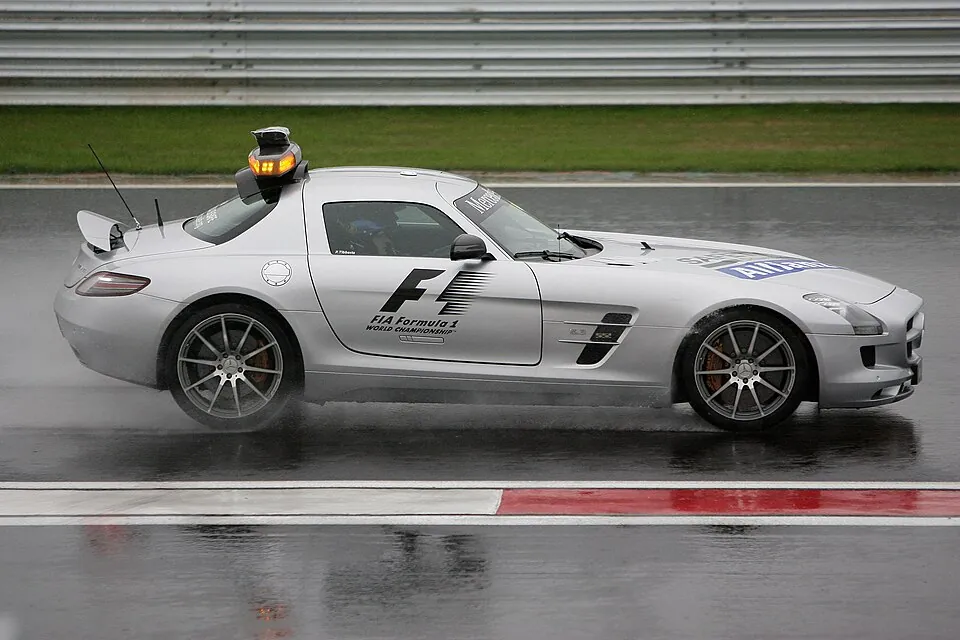
Recognizing the hazards of disparate promoter vehicles, Formula 1 standardized safety cars mid-season in 1996 through an exclusive partnership with Mercedes-Benz. The German manufacturer debuted the high-performance C 36 AMG, establishing dedicated technical baselines. Pacing consistency expanded further at the 2000 Australian Grand Prix when Bernd Mayländer took over sole driving duties, a role he maintained across subsequent decades in Mercedes and Aston Martin vehicles.
Decades of on-track development transformed the safety car from an erratic experiment into an essential regulatory pillar. Modern race control uses standardized pace vehicles not only to manage track hazards and marshal safety, but also to anchor competitive race strategy. Pacing periods fundamentally alter tactical decisions, as governed by modern F1 Safety Car pit lane rules, shaping how teams plan mandatory stops and restart execution.