In this article
Origins and Structure of the MotoGP Sprint
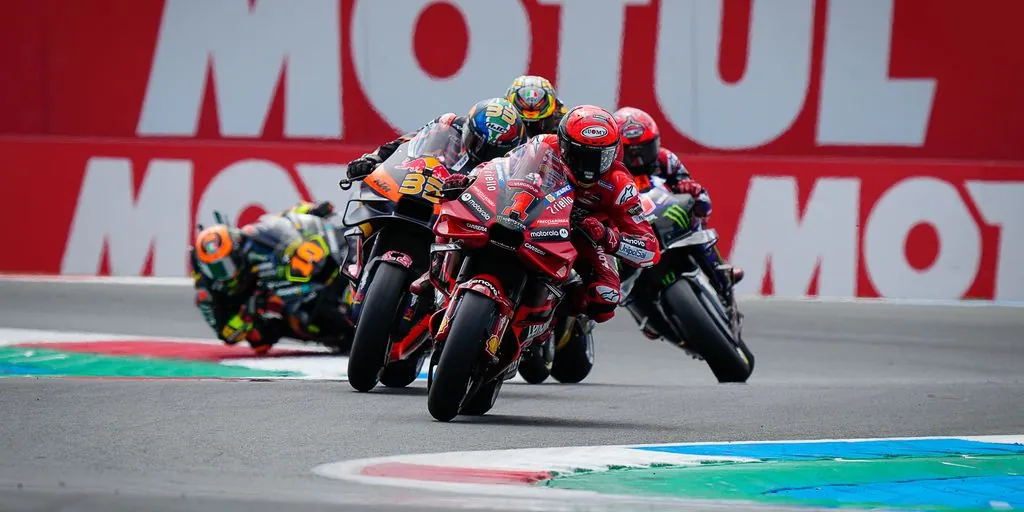
Introduced for the 2023 season, the MotoGP Sprint race—known as the Tissot Sprint—has the ability to deliver high-adrenaline racing as a contest staged on Saturday afternoon. It operates under the same sporting rules as the Sunday Grand Prix but runs across roughly half the distance.
Whereas a full MotoGP race usually lasts for 40 to 45 minutes, the Sprint is scheduled for approximately 50 percent of the laps of the main race and lasts for around 20 minutes.
This condensed format maximises the track spectacle across the entire Grand Prix weekend. By offering fans a high-adrenaline Saturday afternoon contest ahead of Sunday's full-distance event, the Sprint can impact how competitors approach each meeting. Riders battle for points awarded at roughly half the value of the primary race, establishing an early competitive benchmark before Sunday's showpiece.
Friday Practice and the Path to Qualifying
The Sprint takes place at 3:00 pm on Saturday, anchoring a restructured race weekend schedule. Track running for the premier class begins on Friday morning with a 45-minute practice session, followed by an intensive 60-minute afternoon session. Friday afternoon practice is timed directly against the clock to determine the initial qualifying split.
During that one-hour afternoon session, the ten fastest competitors secure automatic advancement into Qualifying 2. The remaining riders are filtered into Qualifying 1. Because single-lap pace on Friday directly dictates qualification entry, teams face more pressure to find an effective baseline setup before Saturday track action commences.
Saturday Qualifying and Grid Determination
Saturday begins with a final 30-minute practice session designed to help teams prepare for timed qualifying. Grid positions for both the Saturday Sprint and the Sunday Grand Prix are decided through a single qualifying procedure. The fastest two riders in the 15-minute Q1 session advance into Q2, joining the top ten from Friday to contest the leading twelve starting spots.
Because that single qualifying process establishes starting positions for two separate contests rather than one, every flying lap carries heightened stakes. Riders face intense pressure to deliver clean qualifying laps, as any mistake penalises their starting position for both the Saturday afternoon clash and the full-distance Grand Prix on Sunday.
Sunday Schedule and the Warm-Up Routine
Once qualifying concludes, riders line up at 3:00 pm for the first point-scoring race of the weekend. Following Saturday's compact contest, premier class competitors return to the circuit on Sunday morning for a brief 10-minute warm-up session. This short outing provides a final opportunity to check motorcycle behaviour before Sunday's main race begins at 2:00 pm.
The overall itinerary provides spectators with high-stakes competitive running across each day of the event. Friday afternoon practice features timed advancement, Saturday delivers an intensified half-distance race, and Sunday serves as the headline Grand Prix. This structure maintains continuous sporting narrative and entertainment across all three days.
Related posts
MotoGP Rules & Flags
What Are the FIM MotoGP Race Stewards and How Do They Rule?
MotoGP Rules & Flags
MotoGP Track Limits Rules: Penalties, Boundaries and Appeals
Sprint Scoring System and Historical Record Keeping
Points in the Sprint are awarded strictly to the top nine finishers on a dedicated scale. The winner receives 12 points, the runner-up collects 9, and the third-place finisher earns 7. Fourth through ninth places receive 6, 5, 4, 3, 2, and 1 point respectively, while tenth place and below score zero.
By contrast, Sunday's race pays out down to fifteenth place, rewarding the victor with 25 points. This proportional difference ensures that Sunday's feature event still carries the greatest championship influence. Furthermore, Sprint victories are not counted as Grand Prix victories, and Sprint win tallies are not a deciding factor in breaking end-of-season championship ties.
Technical Regulations: Fuel Limits and Track Boundaries
Although the Sprint shares general sporting guidelines with the main event, technical rules reflect its shorter duration. A motorcycle's fuel capacity in the Sprint is limited to 12 litres, compared to the 22 litres permitted on Sunday. This lower fuel volume corresponds to the halved race distance and alters bike weight balance throughout the 20-minute contest.
Track limits enforcement also becomes considerably tighter on Saturday. During Sunday's full-length race, riders are permitted up to five track limit infringements before receiving a penalty. In the Sprint, stewards hand out penalties after only three infringements. This narrower tolerance forces competitors to maintain precision while battling aggressively in close packs.
Rider Strategy, Physical Intensity and Tyre Usage
The shortened running format alters both riding tactics and physical strain. Whereas in practice and qualifying competitors may have brief moments of respite between runs, in the Sprint there can be none. In the short and intense Sprint, rider concentration and physical exertion must be just that, while in the Sunday race the emphasis can sometimes shift to a more measured and sustainable expenditure of energy.
From a tactical perspective, while tyre-management strategy for race rubber may not be quite as significant in the shorter Sprint as it is in the longer Grand Prix race, riders often need to be more aggressive and pounce on every opportunity in the Sprint, knowing there is less time to make progress and gain positions. Furthermore, a Sprint result can ease or increase pressure on a rider and team ahead of Sunday.
How Sprint Races Can Influence Championship Battles
Saturday scoring plays a pivotal role in title outcomes, demanding relentless consistency alongside outright speed. During the 2024 championship, Jorge Martin won three Sunday Grand Prix races compared to 11 victories for runner-up Francesco Bagnaia. Both competitors secured seven Sprint victories across the season, but Martin built a decisive margin through frequent Saturday podium appearances.
Martin finished inside the top three across 16 Sprints in 2024, outscoring Bagnaia by 43 points on Saturdays. That Saturday tally successfully overhauled the 33 points by which Bagnaia outscored him on Sundays, propelling Martin to the world championship title by a ten-point margin. The outcome proved that regular Sprint podiums could offset a deficit in Sunday victories.
Fan Reception and High-Stakes Championship Drama
Fan response to the Sprint has been overwhelmingly positive, drawing praise for how competitive momentum builds across practice, qualifying, and twin races. The extra burst of Saturday competition enhances weekend entertainment and deepens season-long rivalries. It also provides sporting influence that carries into the subsequent day's longer race.
That dramatic impact surfaced clearly at the 2023 Valencia season finale. Martin won a thrilling Saturday Sprint, closing the gap to championship leader Bagnaia to 14 points heading into Sunday's race, which set up a dramatic showdown that Bagnaia ultimately won. This ongoing drama has continued to generate substantial spectator buzz at Grand Prix events.