In this article
Contact Patch Mechanics on Dry Asphalt
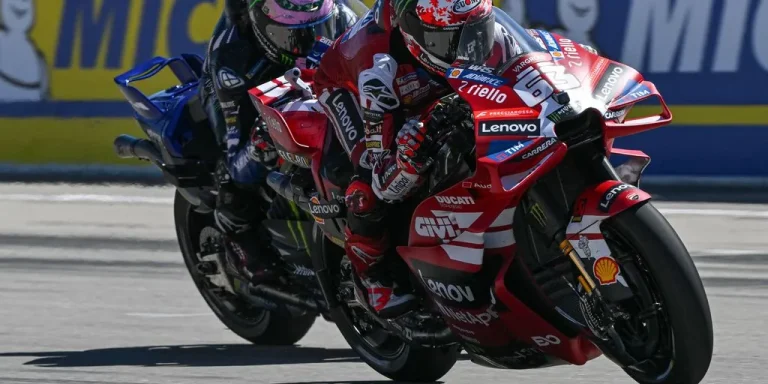
On ordinary street motorcycles, a completely treadless tyre indicates severe wear. Premier-class Grand Prix prototypes reaching speeds beyond 360 km/h deliberately compete on smooth racing rubber. Grip between the tyre and asphalt relies primarily on two variables: the total surface area contacting the track—known as the contact patch—and the physical quality of the rubber compound.
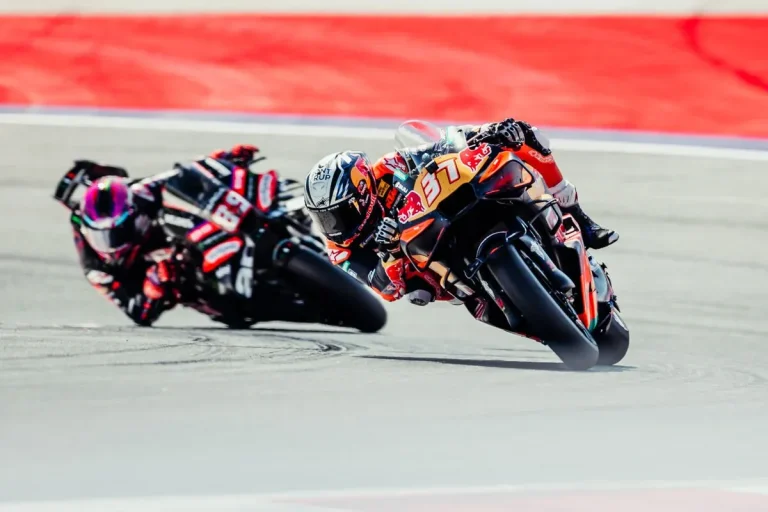
Every tread groove carved into a tyre reduces the rubber area touching the asphalt. On dry track surfaces, grooves waste valuable contact space and lower usable adhesion. Smooth slick tyres maximise surface area across the asphalt footprint. This expanded contact patch gives riders higher grip levels for hard braking, acceleration and extreme cornering at lean angles reaching up to 64 degrees.
Thermal Operating Windows and Rubber Composition
Grand Prix slick rubber differs fundamentally from conventional road tyre designs. Standard street tyres function across ambient conditions and wet roads without generating high operating heat. A MotoGP slick uses a much softer rubber blend tailored to operate within a specific thermal window of roughly 80°C to 120°C. Within that temperature range, the surface becomes stickier and grip increases substantially.
Operating below this window leaves tyres underperforming, making early laps critical for heat management alongside pre-session tyre warmers. MotoGP slicks prioritize maximum dry grip over longevity, designed to operate across typical race distances of 110 to 120 kilometres. Dedicated soft-compound qualifying tyres provide even greater grip over shorter stints, allowing riders to extract maximum single-lap speed.
Water Clearance and Flag-to-Flag Transitions
Slick tyres cannot displace standing water on wet or damp circuits. When moisture coats the asphalt, the smooth profile glides across the water film rather than penetrating it. This condition—termed aquaplaning—separates rubber from the track surface, causing severe loss of grip and frequent crashes. Tread grooves on dedicated wet tyres exist solely to channel surface water away from the contact patch.
During changing weather, competitors make critical tactical calls. Remaining on treaded wet tyres provides stability on soaked sectors but forfeits speed on drying tarmac. Under flag-to-flag rules, riders can enter pit lane mid-race to swap between dry and wet motorcycle set-ups if track conditions demand the transition.
Related posts
Compound Selection and Identification Markings
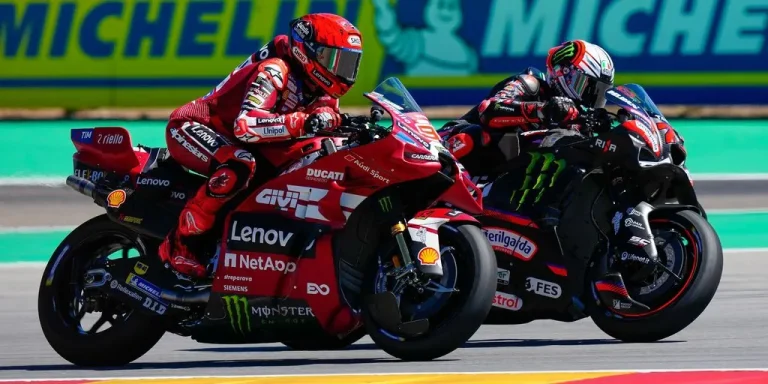
Although slick specifications share an identical smooth external profile, their underlying compound properties differ significantly. Tyre suppliers provide three distinct dry compounds: soft, medium and hard. Visual identification relies on designated sidewall colour bands. Hard tyres carry yellow markings, soft tyres display white bands, and medium specifications feature black sidewalls or no coloured mark at all.
For each Grand Prix event, the tyre manufacturer selects two of the three dry compound specifications according to circuit abrasiveness and layout. Softer rubber reaches working temperature rapidly and offers immediate grip, but suffers accelerated tyre degradation. Harder blends take longer to build heat and yield marginally lower peak traction, but resist wear on abrasive tracks.
Tyre Allocations and Operational Factors
Medium compounds offer a functional compromise, balancing stability and wear resistance without matching the outright peak grip of soft rubber. Each premier-class rider receives an allocation of 22 Michelin slick tyres per Grand Prix weekend, consisting of 10 front tyres and 12 rear tyres. Riders select their compound distribution from the specifications brought to that round.
Championship teams and riders determine their session compound choices by analyzing track temperature, circuit abrasiveness, race distance and individual riding style. Furthermore, as Ducati engineer Riccardo Savin explained, changing fuel loads and ongoing tyre wear serve as crucial factors in how each Grand Prix plays out.
Evolution from Treaded Rubber to Universal Slicks
Motorcycle grand prix racing relied entirely on treaded road-style rubber until the 1970s. As engine output climbed during the early 1970s, motorcycle power exceeded the grip limits of treaded profiles, prompting teams to remove tread patterns to enlarge the tyre footprint. Slicks spread rapidly through the paddock over subsequent seasons.
A key transitional milestone occurred in 1975 when Giacomo Agostini secured his final 500cc world championship using a smooth rear slick paired with a treaded front tyre. By the early 1980s, slick tyres had become standard across premier-class motorcycle racing. Modern prototypes maintain that treadless design, supported by advanced manufacturing standards, complex internal construction and specialized chemical compounding.
Tyre Suppliers and Upcoming 2027 Regulations
Michelin has served as the exclusive tyre supplier for the MotoGP premier class since 2016, with its contract running through the 2026 season. In the junior Moto2 and Moto3 classes, Pirelli has held sole supplier duties since 2024. This split arrangement marks a defined regulatory era in Grand Prix motorcycle paddocks.
A major supplier shift occurs in 2027 when Pirelli becomes the sole tyre supplier across all three categories: MotoGP, Moto2 and Moto3. Simultaneously, Michelin becomes the exclusive supplier for the FIM Superbike World Championship. The tyre transition coincides with sweeping 2027 technical regulations, including engine displacement reductions from 1000cc to 850cc prototypes.
Sources: Why Do MotoGP™ Bikes Use Slick Tyres? The Science Behind Racing Rubber.