
At a glance
- F1 brake discs glow red because friction between the pads and discs heats them enough to emit visible light.
- Carbon-carbon tolerates severe thermal demands, but glowing brakes still need effective cooling.
- A red glow alone does not establish that the brakes are dangerously overheated; temperature must stay within the system’s operating limits.
In this article
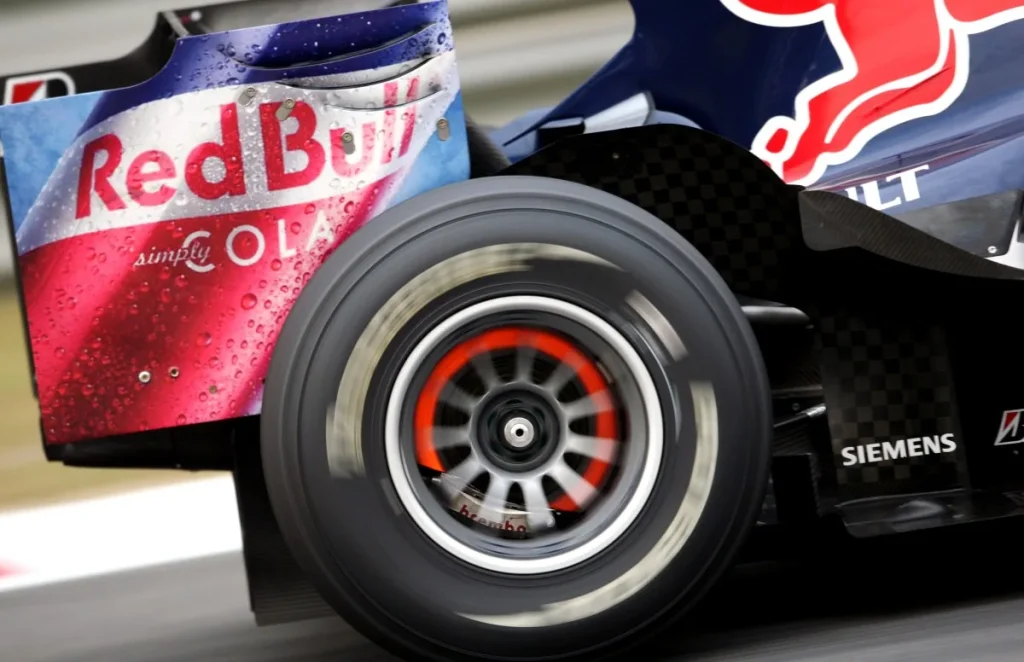
F1 brake discs glow red when the heat generated during braking becomes visible. As the pads act against the discs, friction produces an intense rise in temperature. The disc itself emits light: the red colour is a visible expression of that heat.
The 24 Hours of Le Mans’ technical explanation describes the same physical process in endurance racing. It also explains why the effect becomes particularly striking at night, when the glow is easier to see.
How hot are glowing F1 brakes?
The temperatures involved can be extreme. In its January 2014 explanation of F1 carbon brakes, Auto123 reported that disc temperatures could exceed 1,200°C under the most severe braking conditions. That is a historical account of heavy braking, rather than a temperature every F1 disc must reach before it glows.
The Le Mans explanation describes visible reddening below those extreme peaks. Its figures illustrate the relationship between temperature and glow in endurance racing:
| Temperature described by Le Mans | Visible effect described |
|---|---|
| Around 600°C | A carbon disc begins to emit a red glow. |
| Above 1,000°C | The brakes glow more brightly, especially at night. |
These figures describe the source’s endurance-racing context. They are not universal F1 operating targets or a precise temperature scale for interpreting an F1 photograph.
Related posts
Suspension & Brakes
F1 Suspension and Brakes: Managing Load Through a Corner
Why carbon-carbon suits the job
The material has to cope with more than a single burst of heat. Auto123 identifies resistance to thermal expansion, temperature gradients and thermal cycling as reasons carbon-carbon suits F1 brakes. Those properties address both uneven heating within a component and repeated changes in temperature.
Heat resistance does not mean that the objective is to keep the brakes as cold as possible. CNET’s 2015 account of F1 brake testing notes that race brakes perform poorly when cold. Effective braking therefore depends on managing temperature, rather than simply removing the maximum amount of heat.
How the discs shed heat
Ventilation is part of that management. Auto123 explains that holes in the discs help dissipate the intense heat generated during braking. A disc must withstand the heat while also allowing it to escape.
Does red mean the brakes are failing?
A glowing disc is not, by itself, evidence of a failure. The Le Mans explanation describes reddening as an expected phenomenon when the brakes remain within their intended operating limits.
The concern is excessive temperature combined with insufficient heat dissipation. That can accelerate pad and disc wear and reduce braking efficiency.
Image credit: Representative image. · Source: ebeasts.com · Modifications: Optimized to WebP; earlier source editing history is unverified · Image source