At a glance
- F1 Safety Car unlapping needs an official instruction and a green light; it is not automatic.
- Eligibility depends on a defined timing snapshot, rather than simply who is lapped when the instruction arrives.
- The Safety Car normally returns to the pits at the end of the following lap after the unlapping message. The Race Director can keep it out if necessary.
- A restart signal does not immediately permit normal racing overtakes. The Control Line restriction and specified exceptions still apply.
In this article
F1 Safety Car unlapping lets eligible backmarkers pass cars on the lead lap and the Safety Car. They then travel around the circuit to rejoin the queue. This is an instructed procedure, rather than permission to start racing through the field.
A driver is lapped when another competitor gets a full lap or more ahead and passes them. Formula 1’s official glossary distinguishes that from unlapping by catching and repassing the car that lapped them. Under the Safety Car, separate rules govern the permission to pass.
This guide uses the 2026 FIA Sporting Regulations, Section B, Issue 09, dated 1 October 2026. The relevant provisions are in Article B5.13. This article focuses on its unlapping and restart provisions.
How F1 Safety Car unlapping differs from queue sorting
The Safety Car can join the circuit ahead of cars other than the race leader. Under B5.13.4, the Race Director can use its green light to instruct cars between it and the leader to pass. Those cars continue at reduced speed, without overtaking, until they reach the back of the queue.
That instruction sorts the queue so the leader can follow the Safety Car. It is distinct from the instruction that releases eligible lapped cars. Seeing a green light therefore requires knowing which procedure Race Control has ordered.
Who is eligible to pass?
If track conditions are unsuitable for overtaking, the Race Director sends an instruction that overtaking will not be permitted. Unlapping is not a compulsory part of every Safety Car period.
When the Race Director considers it safe, the official message is “LAPPED CARS MAY NOW OVERTAKE”. The Safety Car’s green light also illuminates. Eligible lapped cars are then required to pass the cars on the lead lap and the Safety Car.
Eligibility follows a precise snapshot in B5.13.4. For each car, identify the lap in which it crosses the first safety car line for the second time after deployment. The car qualifies only if it was lapped when it crossed the Control Line at the end of that lap.
A car that falls a lap down after this cut-off is not eligible for that release. Checking only its position when the message appears would miss this condition.
Related posts
What drivers do during unlapping
Lead-lap cars must stay on the racing line while the eligible cars pass, unless a deviation is unavoidable. After passing the Safety Car, the released cars continue at an appropriate speed without overtaking. They must make every effort to reach the back of the queue.
Once those cars have passed, the Safety Car’s green light goes out. That ends this passing permission, while the other exceptions in B5.13.2 remain applicable. The Race Director may also close pit exit as the Safety Car and queue approach and pass it while released cars are circulating.
| Instruction or signal | What it permits or requires | What it does not mean |
|---|---|---|
| Green light for cars ahead of the leader | Those cars pass the Safety Car and return to the rear | Every lapped car has been released |
| Unlapping message and green light | Eligible lapped cars pass the lead-lap cars and Safety Car | Normal racing and overtaking have resumed |
| Safety Car withdrawal message and orange lights out | Drivers prepare for its return to the pits | All drivers may immediately overtake |
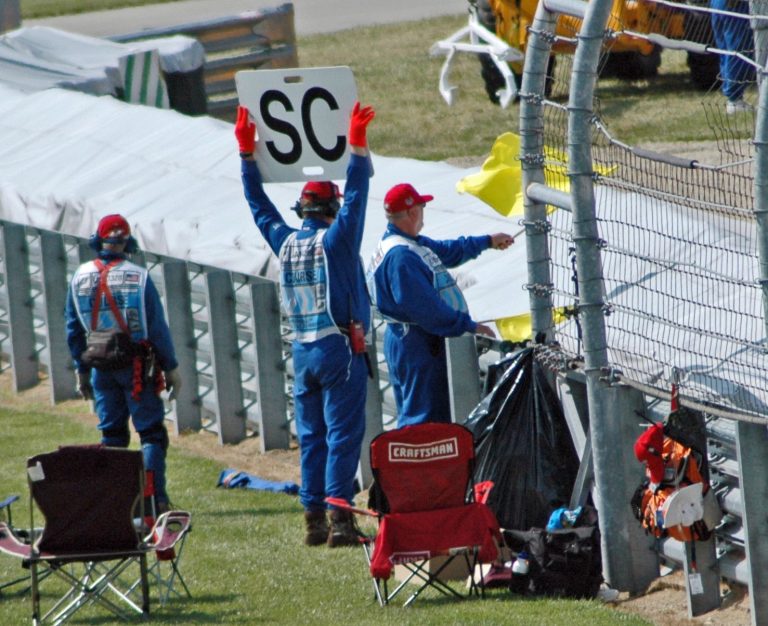
For the wider set of trackside signals, see our F1 flag guide.
When racing can restart
B5.13.5 measures the next step from the unlapping message. Unless the Race Director considers its presence still necessary, the Safety Car returns to the pits at the end of the following lap.
The wording does not promise that every released car will catch the queue before the restart. It requires those drivers to make every effort to rejoin it.
The withdrawal message and extinguished orange lights let the first car behind the Safety Car set the pace. It may fall back beyond the usual maximum gap to the Safety Car.
From orange lights out until the Safety Car enters pit entry, drivers must avoid erratic acceleration or braking. They must not endanger other drivers or impede the restart. No part of a car may run alongside any part of the car ahead during that interval.
For normal racing passes, B5.13.2 still requires drivers to cross the Control Line for the first time after the Safety Car has entered pit entry. The listed exceptions, including authorised unlapping, are separate permissions; they do not remove that restart restriction.
Image credit: Liauzh · Own work · Modifications: Resized by Wikimedia Commons; otherwise unchanged · Image source · CC BY-SA 4.0