In this article
Annual MotoGP Race Count
The MotoGP World Championship calendar schedules a record 22 Grand Prix events across five continents for the 2025 and 2026 seasons. Each Grand Prix weekend features a Saturday MotoGP Sprint alongside the Sunday feature race, giving riders 22 Grands Prix and 22 Sprints across the championship year. This growth reflects how the series transformed from a European-focused competition into a global sporting and entertainment product.
Beyond the premier category, each Grand Prix weekend includes races for the Moto2 and Moto3 support championships on Sunday. In total, fans can watch riders across the three main World Championship categories racing on 88 occasions throughout the season when the Saturday MotoGP Sprint format and the Moto2 and Moto3 races are included in the tally.
Weekend Format and Race Distances
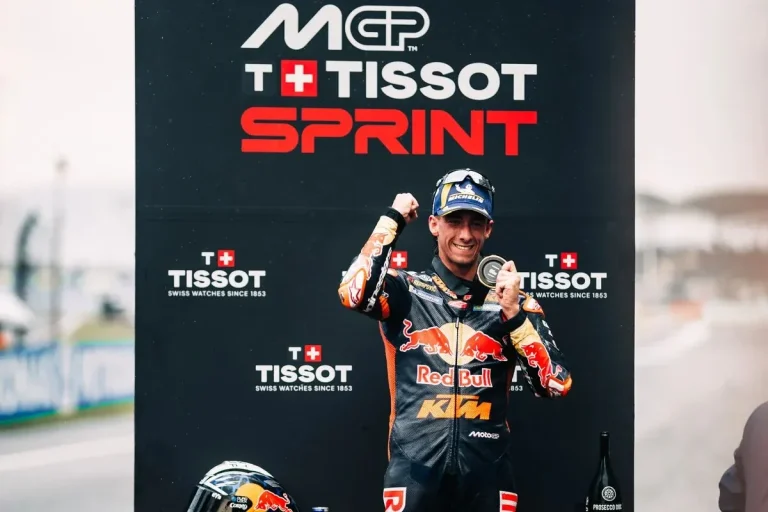
At each venue, alongside Free Practice, Practice, and Qualifying sessions, grand prix weekends feature distinct competitive races. Premier-class competition begins on Saturday afternoon with the MotoGP Sprint. Held over approximately half the distance of a main MotoGP race, the sprint format became part of the Grand Prix schedule in 2023 to add more race action and drama to the championship.
Sunday track action features the Moto3 and Moto2 races on Sunday morning and early afternoon. The main feature-length MotoGP race takes place on Sunday afternoon as the primary contest of the weekend. General race disruption procedures and regulations are covered in MotoGP red flag restart rules.
Decades of Calendar Expansion
The number of Grands Prix per season has increased steadily since the World Championship was founded in 1949. That inaugural season featured just six Grands Prix. Over subsequent decades, the schedule expanded to eight rounds in 1959, 12 in 1969, 13 in 1979, and 15 by 1989. The calendar then reached 16 Grands Prix in 1999 before rising to 17 in 2009.
Growth continued over subsequent decades as the schedule expanded to 19 events in 2019 and reached a record 22 Grands Prix in 2025. Between 1949 and 2025, the calendar expanded by 16 events per season, representing a 267 percent increase in annual Grands Prix. Over the 25 years between 1999 and 2025, the schedule grew from 16 to 22 events, marking a 37.5 percent increase.
Logistics and Safety Standards
In the early years of the championship, transporting bikes, parts, and teams across continents could be difficult and costly, limiting the number of feasible races. Early accounts describe riders themselves transporting bikes on long-haul train and truck journeys to compete. Modern cargo air transport, highly efficient logistical planning, and standardised paddock equipment now mean MotoGP can move across continents within a week.
More purpose-built and modernised tracks meeting strict FIM safety standards have been constructed, which makes hosting more events possible. The calendar combines newer circuits like Buriram and Mandalika with historically famous venues such as Assen, Circuit de Barcelona-Catalunya, Le Mans, Mugello, Phillip Island, and Silverstone. Today, factory-supported teams, satellite teams, and global sponsors make longer seasons financially viable.
Related posts

Global Commercial Reach
MotoGP expanded as it transformed from a European-focused racing series into a global sporting and entertainment product. Consistent live international television broadcasting from the early 1990s made MotoGP a global product, gaining further momentum in the digital era. Broadcasters, circuit owners, manufacturers, sponsors, partners, and fans have driven growth into key motorcycle markets across Asia, the Americas, and the Middle East, including Thailand, Indonesia, and Japan.
Season Timing and Geographical Flow
The MotoGP season typically starts in March following several pre-season tests and runs through the year, ending in November. The 2025 calendar opened with non-European rounds across Thailand, Argentina, the United States, and Qatar. The championship then embarked on 12 consecutive Grands Prix in Europe. Usually in July and/or August, in the middle of these European rounds, a three-weekend summer break allows everyone involved time to rest.
Following the European run, the championship undertakes flyaway rounds in Australasia, visiting Japan, Indonesia, Australia, and Malaysia. The season then concludes with final European rounds in Portugal and Valencia. This structured routing visits five continents across 22 Grands Prix before crowning the champion at Circuit Ricardo Tormo in Valencia.
Championship Points and Historical Deciders
Over the season, the rider who accumulates the most points across 22 Grand Prix races and 22 Sprints will be crowned World Champion. With 22 Grands Prix on the MotoGP calendar, the maximum possible points total is 814, though winning every Sprint and Grand Prix race is highly unlikely for any rider, given how fierce the competition is between the riders.
Title fights can go right down to the final race of the season, and World Championships can be won or lost by the finest of margins.
Historic title fights demonstrate that narrow margins have occurred even with fewer races on the schedule. Nicky Hayden secured his 2006 world title at the final weekend of a 17-race season with two victories. In 2013, rookie Marc Marquez clinched the championship by four points in the 18th and final race at Valencia by finishing third, while rival Jorge Lorenzo won the race.
Recent 20-race seasons produced similarly tight conclusions. In 2022, Francesco Bagnaia overturned a 91-point deficit to Fabio Quartararo to secure the title at Valencia. Bagnaia retained the crown at Valencia in 2023 when Jorge Martin crashed out. In 2024, Martin won the title at Circuit de Barcelona-Catalunya across 20 Grands Prix, taking three Sunday feature victories and seven Sprints to claim the championship.
Future Additions and Support Series
The 2026 calendar also features 22 Grands Prix, including a return to Brazil for the first time in 22 years at Goiânia for round two in March. The Argentina Grand Prix at Termas de Río Hondo is omitted for 2026, though Argentina will return to the calendar in 2027 at the renovated Autodromo Oscar y Juan Galvez near Buenos Aires.
Another development for 2026 is the launch of the Harley-Davidson Bagger World Cup across six MotoGP weekends. This 12-race series will feature at selected Grands Prix across Europe and North America, with riders competing on race-prepared Harley-Davidson Road Glide motorcycles in two races per round.
Sources: How Many Races Are In A MotoGP Season?.