In this article
In MotoGP, mere tenths of a second can separate a winning machine from one that finishes outside the leading positions. Honda, KTM, and Yamaha represent three major manufacturers in motorcycle racing's elite world championship. Although their prototypes are built under identical technical regulations, significant differences persist in how each brand seeks to generate speed. For 2026, a fundamental shift means all three compete with V4 engines. Yamaha abandoned its historic inline-four at the end of 2025 to develop a new V4-configured YZR-M1, moving closer to the engine architecture long deployed by Honda and KTM. However, sharing an engine layout does not make these motorcycles identical.
Honda RC213V: Japanese Tradition and Aluminium Chassis
Honda's RC213V represents the continuation of a concept first introduced to MotoGP in 2012, backed by the Japanese brand's extensive history in the category. The machine houses a 1,000 cc V4 engine that produces more than 180 kW—equating to over 240 CV according to Honda data—housed within a traditional aluminium twin-spar chassis. Engineering efforts at Honda focus heavily on striking a balance between cornering capability, chassis flexibility, and stability. For the 2026 season, the factory introduced an evolved engine alongside significant modifications to the rear section and aerodynamics of the RC213V.
Related posts
KTM RC16: The Difference in the Chassis
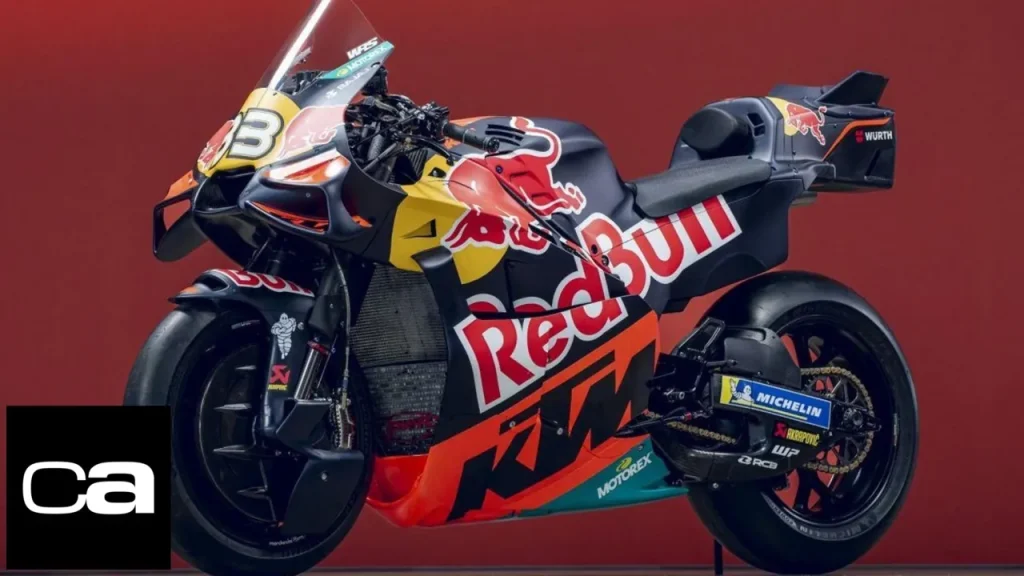
KTM charts a different course with the RC16, establishing its sharpest contrast with Honda and Yamaha beneath the fairing. The Austrian marque entered MotoGP utilizing a tubular steel chassis, an uncommon path against the aluminium frames favoured by rivals. In 2023, KTM took a further step by introducing carbon fibre into its chassis construction. Carbon fibre delivers a very light structure and offers an alternative way to manage rigidity and flex, though it presents complexity because its dynamic behavior can be harder to predict and alter than a conventional aluminium frame. In 2026, the RC16 continues as KTM's premier-class prototype, campaigned by both the factory squad and Tech3.
Yamaha YZR-M1: A Revolution for 2026
Yamaha's situation is probably the most distinctive. For decades, the inline four-cylinder engine stood as the defining identity of the YZR-M1, delivering premier-class titles with Valentino Rossi, Jorge Lorenzo, and Fabio Quartararo. Yamaha ended that lineage to compete with a V4-powered M1 starting in 2026. The new 1,000 cc V4 powerplant is declared by Yamaha to produce more than 275 CV, matched to an aluminium twin-spar chassis similar in material choice to Honda. Because a V4 layout alters dimensions, weight distribution, aerodynamics, and dynamic behavior, Yamaha had to develop what is practically a brand-new motorcycle concept rather than simply swapping engines.
What Is the Main Difference?
In simple terms, Honda relies on the evolution of its aluminium-framed V4 RC213V, KTM distinguishes itself through its carbon-fibre chassis, and Yamaha undergoes a historic transformation by abandoning the inline-four to develop a new V4 M1. All three seek the same outcomes: acceleration, top speed, stability, cornering capability, and tyre preservation over a full race distance. The difference lies in how each manufacturer attempts to achieve that balance. This variety highlights MotoGP's technical appeal, where teams share the same regulations yet pursue speed through distinctly different engineering solutions.