In this article
Governance and Technical Boundaries
The FIM Grand Prix World Championship Regulations establish the sporting and technical framework of MotoGP. The Grand Prix Commission—uniting the FIM, Dorna Sports, IRTA, and the MSMA—formulates and updates these rules, while the FIM oversees overall enforcement. Premier class entrants construct custom prototype machines adhering to explicit physical limits: engine displacement cannot exceed 1000cm3, minimum dry weight is 157kg, and fuel tank capacity cannot exceed 22 litres for a full Grand Prix race.
Standard engine durability rules limit each rider to a baseline allocation of seven engines per championship season. A concession system dictated by the Grand Prix Commission applies to participating manufacturers depending on accrued constructor points during specific periods.
Under this mechanism, competing manufacturers can be allowed a greater engine allocation per season (9-10 engines), depending on where they rank in previous constructor points, alongside allowances for test days, test riders, wildcard appearances, engine specifications and freezes, aerodynamic updates, and test tyres.
Tyre Allocations and Selection Protocols
Michelin serves as the sole appointed tyre supplier for the MotoGP class, whereas Pirelli equips the Moto2 and Moto3 categories. In MotoGP, the supplier provides identical specifications and equal quantities to all competitors, offering softer and harder compound options to balance mechanical grip against operational durability. Teams must comply with requests from the Technical Director and the official tyre supplier to check tyre parameters at any time, which may include tyre pressure and temperature data.
At each Grand Prix, riders receive an allocation of 22 slick tyres, split into 10 front and 12 rear tyres. Riders who advance through both qualifying segments receive one additional front and one additional rear slick. The wet allocation comprises 13 rain tyres: six front and seven rear. When handling mixed or drying track conditions, competitors must weigh the higher wet stability of rain treads against the superior lap pace delivered by dry slicks.
Race Weekend Structure and Qualifying
A premier class weekend begins on Friday with a 45-minute Free Practice 1 session, followed by a 60-minute Practice session. The top ten lap times from Friday afternoon earn direct advancement into Qualifying 2 on Saturday morning. Saturday action starts with a 30-minute Free Practice 2, leading straight into two 15-minute qualifying stages.
The opening Qualifying 1 session determines grid slots from 13th backward, while its top two riders join the pole shootout in Qualifying 2.
Qualifying 2 establishes the top 12 starting positions for both the Saturday Sprint and the primary Sunday race. Saturday afternoon features the Sprint, usually lasting around 20 minutes across approximately half the full Grand Prix distance. Following a 10-minute Sunday morning Warm-up, the weekend concludes with the feature-length Grand Prix race on Sunday afternoon, which typically lasts around 40 minutes.
Pit boards, trackside flags, and onboard dashboard alerts inform competitors of operational instructions throughout each session.
Related posts
MotoGP Rules & Flags
MotoGP Flag System: Rules, Flag Meanings and Signals Explained
MotoGP Rules & Flags
MotoGP Rules: Regulations, Weekend Format and Penalty Guide
Trackside Marshalling and Flag Protocols
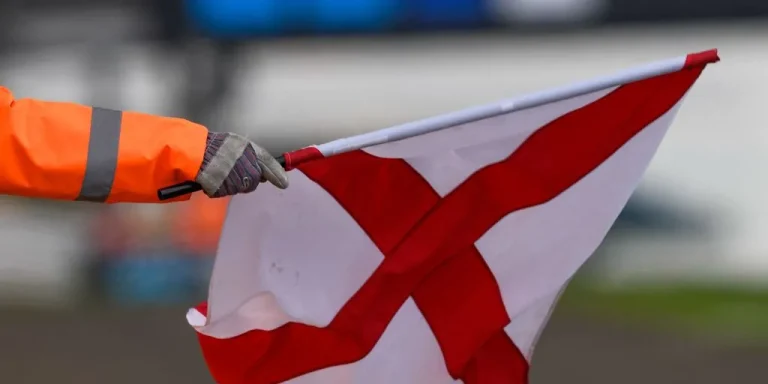
Trackside marshals display safety signals under direction from Race Direction. A yellow flag indicates a dangerous situation where riders may not pass other riders. A white flag indicates rain, where riders may enter pit lane to change to a bike with a wet set-up. A red flag stops a session for safety, requiring everyone to slow down and return to the pits.
A black flag directs a specific rider to their pit box, while a black flag with an orange disk indicates dangerous mechanical trouble requiring immediate withdrawal.
Disciplinary Stewarding and Sporting Sanctions
The FIM MotoGP Stewards Panel investigates sporting infringements and administers escalating disciplinary measures. Formal sanctions range from private warnings and cash fines up to €50,000 to ordered position drops and time penalties up to two minutes. Under MotoGP ride-through penalty serving rules, a rider traverses the pit lane without stopping before rejoining the circuit. Severe rule breaches can trigger practice or race disqualification, point deductions, temporary suspensions, or complete exclusion.
The Long Lap Penalty directs a competitor through an off-line track extension, normally losing around 2-4 seconds, which can cost them a position or several positions in some cases. Under established MotoGP jump start penalty rules, jumping the start brings two Long Lap Penalties. Exceeding race pit lane speed limits likewise incurs two Long Laps. Riders face lap cancellation for exceeding track limits in qualifying, while race infractions trigger a Long Lap Penalty.
Stewards also apply time penalties or ride-through penalties when riders repeatedly ignore previous penalties, as detailed in guides to last-lap Long Lap penalties.
Championship Scoring and Title Deciders
Championship rankings accumulate across the Sprint and Grand Prix races. The Sunday feature awards points down to 15th place on a 25-20-16-13-11-10-9-8-7-6-5-4-3-2-1 sliding scale. The Saturday Sprint rewards the top nine finishers with 12, 9, 7, 6, 5, 4, 3, 2, and 1 point respectively. A rider sweeping both events collects a maximum of 37 points over the weekend, making 814 points the maximum possible total across a 22-round season.
The competitor with the highest points tally at season end secures the MotoGP World Championship. Recent championships have gone down to the final round: Francesco Bagnaia won the 2023 title by 39 points over Jorge Martin, while Martin secured the 2024 crown by outscoring Bagnaia by ten points.
Operational integrity during these title battles relies on Race Direction overseeing track safety, while disciplinary decisions sit with the FIM Stewards Panel before a case can escalate to the FIM Appeal Stewards and then the MotoGP Court of Appeal.
Regulatory Evolution and 2027 Overhaul
Grand Prix regulations evolve across distinct technical eras. Four-stroke machinery replaced 500cc two-strokes in 2002, followed by the flag-to-flag wet race procedure in 2005. Four-stroke formulas subsequently replaced two-stroke intermediate and lightweight classes, creating Moto2 in 2010 and Moto3 in 2012. Technical officials eliminated intermediate tyres from premier class allocations in 2017, and Dorna integrated Saturday Sprints into every Grand Prix weekend starting in 2023.
Major technical changes take effect in 2027 to lower speeds and enhance sustainability. Engine displacement will drop from 1000cm3 to 850cm3, alongside reductions in seasonal engine allocations from seven to six units per rider. Fuel tank capacity will decrease from 22 to 20 litres, machines will run on 100% non-fossil fuel, and aerodynamic devices will face stricter regulatory constraints. Detailed analysis of these changes appears in guides covering MotoGP engine displacement regulations.