In this article
Role and Authority of the MotoGP Flag System
The MotoGP flag system provides vital visual communication between race officials, marshals, and riders during track sessions. Official sporting requirements are defined in the FIM World Championship Grand Prix Regulations. Marshals display flags at dedicated marshal points around the circuit under instructions from Race Direction and the FIM MotoGP Stewards Panel to maintain rider safety and fair competition. This account draws on MotoGP.com reporting.
Safety Framework and Flag Dimensions
Flag rules form part of a broader safety framework that includes circuit standards, the Safety Car, trackside marshals, and rapid medical response teams. FIM regulations stipulate that flags used in the championship should measure 80 centimeters vertically and 100 centimeters horizontally. Officials inspect and verify these physical dimensions on the day preceding the first practice session.
Track Clearance and Green Flag Protocol
A green flag indicates that the track is clear. Marshals must wave this flag at every marshal post during the opening lap of each practice session, warm-up session, sighting lap, and pre-race warm-up lap. Marshals also wave the green flag at an individual post after an incident once track conditions are confirmed safe again following yellow flags.
Yellow Caution Flags and Starting Grid Signals
On the starting grid, waving a yellow flag across each row indicates that the race start is delayed. Displaying it at one or more specific rows warns that a rider on that row faces difficulties. Around the circuit, a single waved yellow flag warns riders of danger beside the track, requiring them to slow down and proceed with caution.
Double Yellow Flags and Surface Hazard Warnings
Two yellow flags waved together at a flag marshal post indicate that there is a hazard wholly or partly blocking the track. The riders must slow down and proceed with caution. Separately, the yellow and red striped flag warns that adhesion could be affected by causes other than rain. Such unexpected surface conditions can include isolated damp patches on a dry track, oil, gravel, grass, or other debris.
Rain Indicators and Flag-to-Flag Bike Swaps
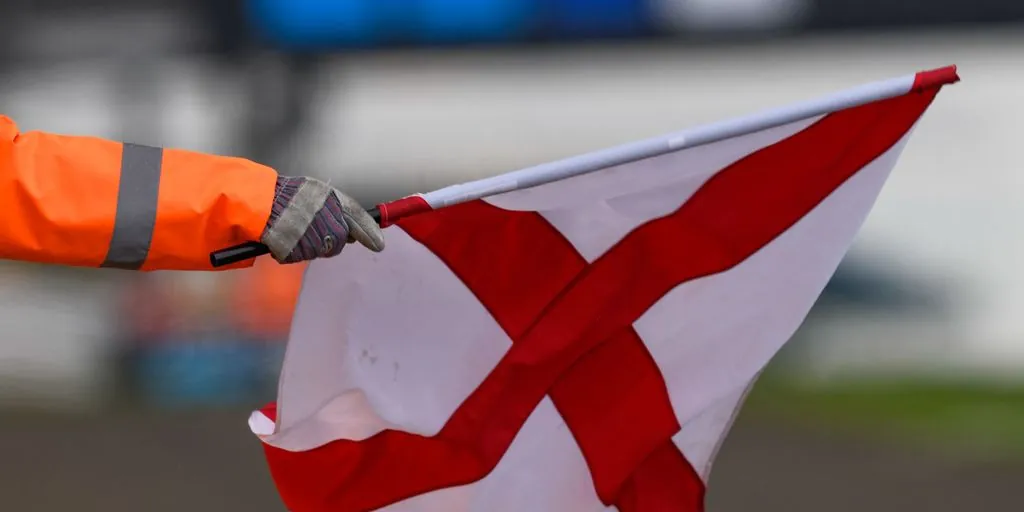
A white flag with a diagonal red cross warns riders of rain drops affecting the track surface. During a race, displaying a plain white flag indicates that riders are allowed to change machines. Only Race Direction can take this decision, meaning the race is under flag-to-flag rules, where riders can change bikes in pit lane under established bike change regulations in certain conditions.
Related posts
MotoGP Rules & Flags
MotoGP Regulations: Technical Specs, Weekend Format and Flag Rules
MotoGP Rules & Flags
MotoGP Rules: Regulations, Weekend Format and Penalty Guide
Blue Flags and Lapping Conduct
The blue flag informs a rider that faster traffic is about to overtake them. In practice sessions, the rider concerned must allow the faster rider to pass. During a race, it indicates that the rider is about to be lapped, requiring them to let the lapping rider or riders through at the earliest opportunity under standard MotoGP blue flag rules.
Individual Black Flags and Disqualification
The black flag conveys instructions to a single rider that they are disqualified. Marshals wave it at each post alongside the rider's competition number. The penalised competitor must enter the pit lane at the end of the current lap and cannot restart when this instruction results from a penalty.
Mechanical Defect Black and Orange Flag
A black flag featuring an orange disk is displayed alongside a rider's number to convey instructions to that competitor alone. This signal informs the rider that their motorcycle has mechanical problems likely to endanger themselves or others, and that they must immediately leave the track. The rider cannot rejoin the track unless authorised to do so by an official.
Red Flag Interruption Procedures
When a practice session or race is being interrupted, typically due to safety reasons, marshals wave red flags at each post and red lights illuminate around the track. Riders must return carefully to the pit lane. When pit exit is closed, red lights switch on and may be accompanied by a red flag, barring riders from exiting under MotoGP red flag restart rules.
Pit Lane and Track Light Signals
Electronic light systems operate alongside flags to enforce track safety protocols. A green light illuminates at the pit lane exit to signal the start of practice sessions, warm-up sessions, sighting laps, and pre-race warm-up laps. Flashing blue lights switch on at pit exit one minute after the green light opens pit lane, switching off only when red lights appear.
Flag Infringements and Steward Penalties
Penalties can be imposed on riders if they fail to acknowledge relevant flags while on track. For instance, overtaking is forbidden in yellow flag zones until reaching a green flag, with infringements resulting in a penalty. Penalties that can be applied to riders are communicated through dashboard signals or pit boards on the pit wall of the start/finish straight.
These include position drops ordered by the Stewards Panel, time penalties adding up to two minutes to race results, or lap time cancellations in timed sessions.
Long Lap and Pit Lane Ride-Through Penalties
Stewards can order a Long Lap penalty, requiring a rider to navigate a designated route outside the racing line that adds two to four seconds to a lap time. Stewards can also mandate a double Long Lap penalty. Alternatively, a ride-through penalty requires riding through the pit lane at the 60 km/h limit without stopping. The rider may then rejoin the race.
Chequered Flag and Finish Protocols
The black and white chequered flag waved at the finish line signals the conclusion of a practice session or race. When trailing riders closely precede the race leader on the final lap before the finish line, marshals display the chequered flag together with the blue flag.
Historical Incidents and Guest Marshals
At the 2013 Australian Grand Prix, tyre supplier Bridgestone calculated tyres could not complete full race distance on newly resurfaced asphalt. Race Direction mandated a bike change on laps nine or ten following flag-to-flag rules. Marc Marquez changed bikes too late, received a black flag, and was disqualified before ultimately securing his debut premier class title.
At the 2020 Austrian Grand Prix, a big Turn 3 crash involving Johann Zarco and Franco Morbidelli prompted marshals to wave yellow and red striped flags, yellow flags, red flags, and activate red lights. During 2024, guest marshals waved the chequered flag, including Jose Mourinho in Portugal, Keanu Reeves in Germany, Mark Webber in Australia, and Sonic the Hedgehog in the Americas.