
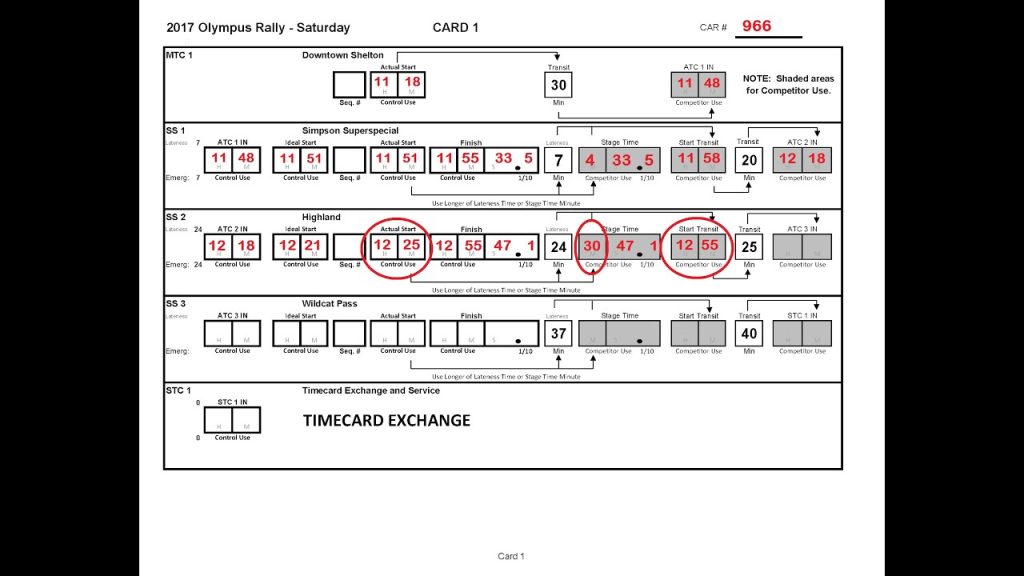
At a glance
- A rally time card records a crew’s passage through controls and its official times.
- The co-driver calculates when the crew is due and presents the card; the marshal makes the official entry.
- Lateness limits and timing penalties are different rules. A maximum permitted delay is not a penalty-free allowance.
What is a rally time card?
It is the document the crew presents at checkpoints so officials can record its progress through the rally. It connects the itinerary, road sections and timed stages. It is separate from the road book, which describes the route, and pace notes, which describe the road ahead on a stage.
The co-driver normally manages the card and works out the next due time. That job matters even when the car is quick: a stage result and a road-section timing penalty are separate parts of the rally’s result.
Who writes on it?
The 2026 WRC Sporting Regulations, version 13 January, Article 19.3, make the crew responsible for the card, presenting it and checking its entries. Officials fill the official fields; the crew uses only areas designated for competitors. Differences between the card and official records are investigated, rather than settled by a crew rewriting a timestamp.
Card formats and handover points depend on the event. There is no universal A5 size, collection time or penalty for losing any item in a navigator’s kit.
Due time, early arrival and lateness
For the cited WRC edition, Article 44 calculates the due minute from the preceding control or stage-start time plus the allowed target time. For example, 13:00 plus 25 minutes gives a 13:25 target minute. Entering the control area and handing over the card are separate steps; crews must observe the prescribed check-in procedure.
The ordinary WRC timing penalties are ten seconds per minute or fraction late and one minute per minute or fraction early. An event may expressly permit early check-in at specified controls. Maximum lateness is a separate limit, not free time before penalties begin.
Road-section target times never authorize speeding. A regional guide’s average-speed convention should not be presented as a worldwide speed limit.
At the end of a stage
The stage time is measured at the flying finish. The crew then stops at the later control for the entry, as explained in our flying-finish and stop-control guide. That stop is not the stage’s timing line.
Use the current championship rules, supplementary regulations and marshals’ instructions for an actual entry. Generic advice cannot decide a puncture procedure, an overshoot or a missing-card case at every rally.
Image credit: Representative image; not a photograph of the reported event. · Modifications: None; original downloaded file · Image source