In this article
Top Speed Limits and Historical Milestones
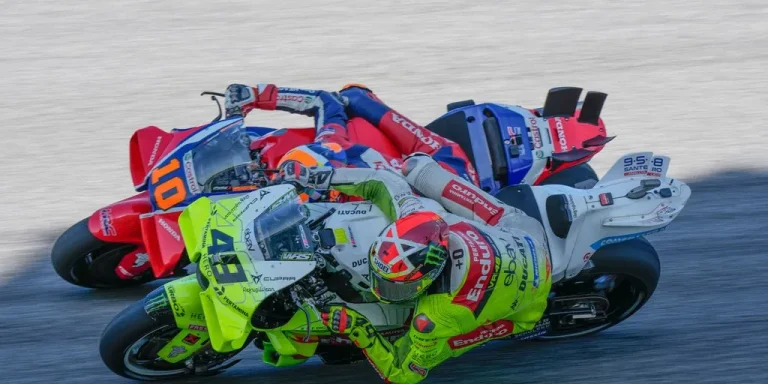
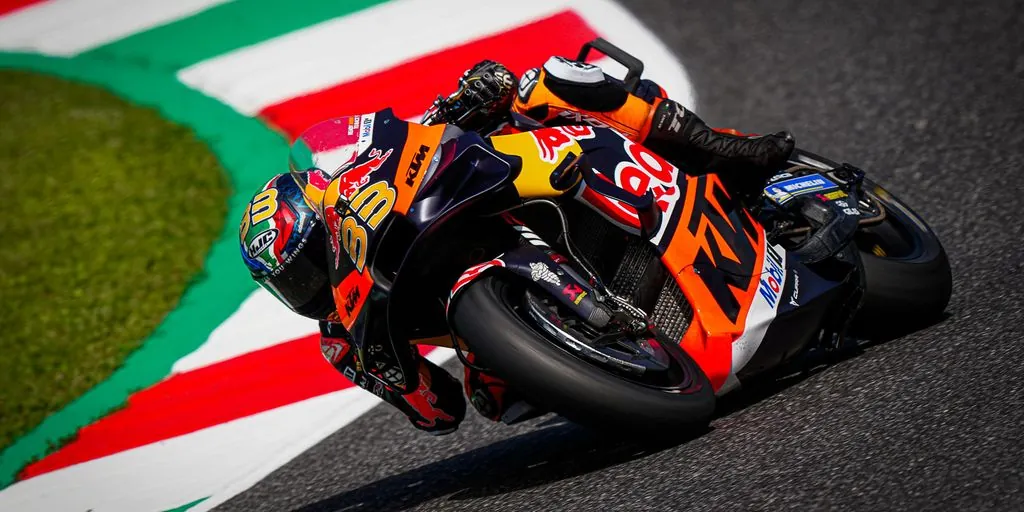
MotoGP prototype machinery regularly exceeds 360 km/h (223.7 mph) during Grand Prix competition, reaching an all-time record of 368.6 km/h (229.04 mph). The bikes can go around three times faster than the permitted road speed limit in many countries. Outright straight-line performance operates alongside intense braking deceleration, steep lean angles through corners, and high-speed slipstream overtakes.
The Speed Trap Benchmark at Mugello
The Italian circuit of Mugello hosts the highest recorded speeds in MotoGP history. Jorge Martin established the outright record of 368.6 km/h during FP2 at Mugello in 2026. Brad Binder reached 366.1 km/h in the 2023 Tissot Sprint, a mark equalled by Pol Espargaro during practice in 2024.
Five entries share third place at 364.8 km/h at Mugello. Enea Bastianini achieved this speed in the 2023 Sprint, while Pedro Acosta matched it in 2024 qualifying. Alex Marquez and Marco Bezzecchi recorded the same mark in the 2024 Sprint, followed by Brad Binder in the 2024 race.
Mugello dominating the top speed records can be attributed to the circuit's specific characteristics, combining a fast, flowing layout with a 1.14 km start-finish straight. The final corner sets riders up to be able to get the gas pinned. Propelled by efficient engines, riders can also benefit from slipstreaming rivals to gain extra speed with less air resistance before braking hard into the San Donato corner at Turn 1.
Circuit Variations and International Records
MotoGP top speed records per circuit vary based on straight length and track layout, with circuit records in addition to Mugello correct as of the start of the 2025 season. Johann Zarco clocked 362.4 km/h at Qatar's Lusail International Circuit in 2021. Enea Bastianini recorded 356.4 km/h at Phillip Island in 2022, matching Maverick Viñales at Circuit of the Americas in 2023.
Franco Morbidelli also achieved 356.4 km/h at Circuit de Barcelona-Catalunya in 2024. Bastianini posted another benchmark of 354.1 km/h at MotorLand Aragón in 2022, while Miguel Oliveira logged 352.9 km/h at Autódromo Internacional do Algarve in Portugal during 2024.
Venues with shorter straights record lower maximum velocities. Silverstone registered 340.6 km/h from Bastianini in 2022, while Andrea Iannone achieved 339.6 km/h at Sepang in 2015. Brad Binder recorded 325.8 km/h at Le Mans in 2023, while Assen saw 319.8 km/h from Iannone in 2015.
In additional circuit records, Pedro Acosta reached 319.5 km/h at Pertamina Mandalika Circuit in Indonesia and 306.8 km/h at the Sachsenring in Germany in 2024. Marco Bezzecchi hit 305.9 km/h at Misano in 2023, while Johann Zarco reached 300.8 km/h at Circuito de Jerez in 2021.
Average Race Pace Across Full Distances
Average speeds across complete race distances also demonstrate high performance when accounting for braking zones and on-track battles. Francesco Bagnaia won the 2024 Italian Grand Prix at Mugello with an average speed of 177.1 km/h (110 mph) across 23 laps and 120.635 km of racing.
Bagnaia also won the 2024 Grand Prix of Qatar, registering an average speed of 177.2 km/h (110.1 mph) over 21 laps and 112.98 km. At Phillip Island, Marc Marquez won the 2024 Australian Grand Prix with a 181 km/h (112.5 mph) average speed over 27 laps and 120.096 km.
Average speeds during races vary considerably based on circuit layout, including corner count, corner types, chicanes, and straight lengths. At the Circuito de Jerez – Ángel Nieto, where the top speed record sits just over 300 km/h (186.4 mph), Bagnaia won the 2024 Spanish Grand Prix at an average speed of 161.9 km/h (100.6 mph).
Slower maximum track speeds do not make the racing less spectacular. Grand Prix events across the entire season feature loud crowds, daring overtakes, last-lap battles, and memorable victories regardless of the outright top speed produced at each venue.
Related posts
Engineering Evolution and Performance Drivers
Grand Prix top speeds have increased steadily across decades, rising from approximately 240 km/h (150 mph) in 1960 to 305 km/h (190 mph) in 1990, 352 km/h (219 mph) in 2011, and over 365 km/h. Engine regulations evolved from 500cc machinery to current 1000cc engines, increasing power-to-weight ratios through lighter, higher-output components.
Electronic systems and ride hardware have also developed substantially over time. Modern prototype machinery incorporates anti-wheelie devices, traction control, rear ride height devices, advanced braking systems, and dedicated aerodynamics, which all combine to help the fastest motorcycles and riders achieve higher speeds.
Tyre development and track maintenance support these mechanical advances. Decades of racing experience enable official tyre supplier Michelin to provide improving rubber compounds that can give increasingly better grip, enhancing total motorcycle performance. Dedicated aerodynamics manage airflow, while regularly maintained circuit surfaces give riders greater confidence and control.
Data analysis conducted by teams pairs with rider fitness levels, riding technique, current form, and race strategy. These elements ensure that competition intensifies and pace continues to rise season after season at the most elite level of motorcycle racing.
Cross-Championship Speed Comparisons
Top speeds in MotoGP run slightly below premier four-wheel categories. Valtteri Bottas reached Formula 1's recorded peak of 378 km/h (234.9 mph) during qualifying for the 2016 Grand Prix of Azerbaijan, while IndyCar competition features a record speed of 380 km/h (236 mph).
Both open-wheel championships achieve marginally faster maximum speeds than MotoGP. Their higher velocities are driven by much larger engines and aerodynamic advantages over motorcycles, while four wheels on the ground provide greater control over acceleration and braking forces.
MotoGP top speeds remain far quicker than production-based motorcycle series and multiple car racing categories. WorldSBK machines reach 339.5 km/h (211 mph), NASCAR stock cars reach 321 km/h (199 mph), and World Rally Championship vehicles record approximately 200 km/h (124 mph).
Fans may wonder how fast prototype motorcycles could travel in a pure straight line if pushed to the absolute limit. However, manufacturers and teams concentrate their technical efforts on championship performance rather than exploring maximum theoretical top speeds.
Rider Safety Protocols at Maximum Velocity
Operating motorcycles at speeds above 360 km/h requires stringent safety standards for competitors and trackside personnel. Riders wear advanced protective equipment, including specialised helmets, racing suits, integrated airbags, boots, and gloves. Prototype motorcycles also incorporate sensors and safety technology from leading manufacturers.
Every Grand Prix venue must also satisfy a strict set of safety requirements to remain on the calendar. These regulations govern track surface quality, run-off dimensions, trackside marshal systems, impact safety barriers, and emergency medical facilities.
At each Grand Prix, track safety is actively overseen and enforced by Race Direction members, the FIM MotoGP Stewards Panel, and the Event Management Committee, which includes the FIM Safety Officer and the FIM Medical Director.
Riding at top speed imposes heavy physical demands regarding heart rate, adrenaline, reflexes, and concentration. Every MotoGP rider trains diligently in order to be able to handle the pressure, the g-forces, and the physical exertion of riding at speeds in excess of 360 km/h.