In this article
The Mechanics of Modern MotoGP Cornering
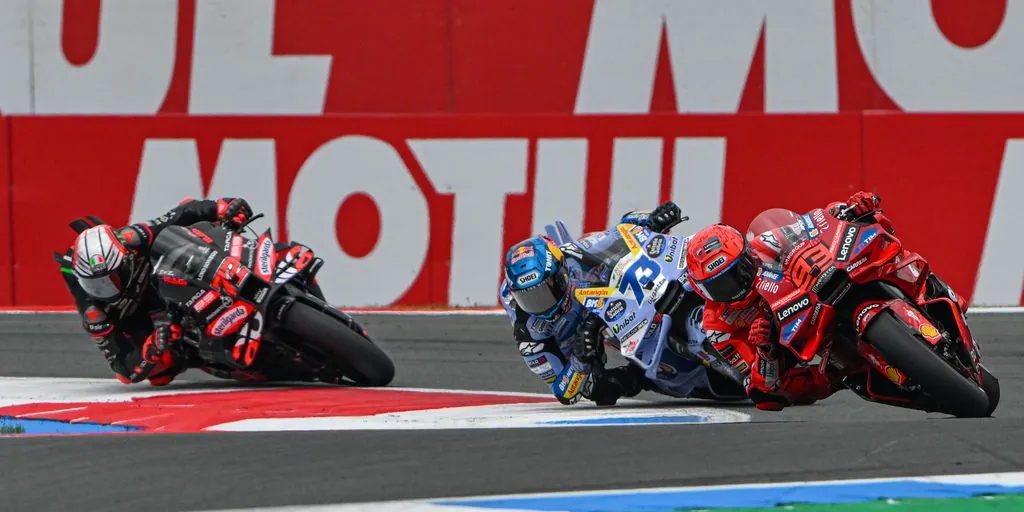
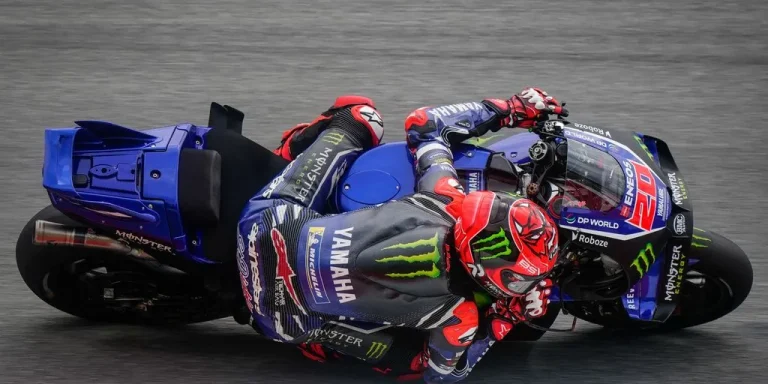
In premier Grand Prix motorcycle competition, elbow dragging represents an advanced riding posture that defines elite cornering execution. Modern competitors routinely lean their machines over at severe angles reaching up to 65 degrees from vertical. As a bike carves through a turn, powerful centrifugal forces pull its mass outward toward the track perimeter. Riders lean inward toward the tarmac to counterbalance this outward lateral force.
Touching an elbow against the racing surface is not an isolated objective for competitors. Instead, contact occurs as an incidental byproduct of extreme lean angle combined with rider body positioning. Rather than staying aligned with the machine's central axis, competitors slide off the saddle, hanging their knees and elbows low to glide smoothly through bends while carrying optimum velocity through every corner phase.
Managing Machine Inclination and Corner Exit
However, MotoGP riders do not want too much lean angle, aiming to take each corner as quickly and safely as possible. Competitors hang their bodies off the side of the bike in order to control, and can even somewhat reduce, the machine's lean angle. They then get back upright as quickly as they can in order to increase acceleration out of the corner.
Riders brake as hard and late as they can to reach the corner apex as fast as they can, leaning their bikes right over through the apex while brushing knees, elbows, and even shoulders against the track surface to maintain stability and control. Riders use contact with the track surface through knee and elbow sliders to help guide their way through the turn.
This contact enables competitors to better judge lean angle, feel track grip levels, stick closely to an optimum corner angle, and take the corner safely and confidently.
Tactile Feedback, Track Limits, and Front-End Saves
Riding at extreme lean involves persistent physical jeopardy. If asphalt grip drops unexpectedly, chassis stability falters, or body position shifts incorrectly, crashes do occur fairly regularly, whilst riders are elbow or knee dragging on cornering. Crashing is part of the sport, and riders often say they would be unable to find the limit in terms of speed or performance unless they occasionally go over that limit.
Sometimes in rare and spectacular cases when riders lean over too much or lose front tyre control against the asphalt, they are capable of remarkable saves whereby they use a knee or elbow to push back up off the ground, prevent a crash, and continue riding safely.
Elbow dragging is not employed uniformly across every corner profile. Riders reserve maximal lean and ground contact primarily for long, sweeping, high-speed bends where centrifugal loads are sustained. Conversely, through tight hairpins, rapid chicanes, and shorter turns, competitors adopt a more upright posture. Furthermore, stylistic preferences vary widely across the grid, with certain competitors choosing conservative body offsets that rarely ground their elbows.
Related posts
Contemporary Riding Intensity and WorldSBK Comparisons
Danilo Petrucci, a popular former MotoGP rider now competing in the WorldSBK championship, observed that cornering style undergoes continuous evolution. Speaking to Motorsport Magazine, Petrucci explained that younger entrants now move across their bikes with extraordinary physical intensity and exaggerated postures. While Petrucci touched elbows during his premier-class career, he emphasized that such dramatic physical displacement was far less prevalent when he first arrived in MotoGP.
Historical Progression from Boot Toes to Knee Sliders
The contemporary practice of touching limbs down originated through decades of ergonomic experimentation. Early Grand Prix riders extended the toe of their boots to gauge track proximity. That tradition shifted when American champion Kenny Roberts won three consecutive 500cc World Championships between 1978 and 1980. Roberts popularized hanging a knee out, drawing inspiration from Finnish racer Jarno Saarinen, who pointed his knee downward before his fatal 1973 Monza crash.
As Roberts repeatedly grounded his knees, he adopted protective sliders, prompting widespread adoption of knee-down posture among competitors as chassis speeds and lean angles rose. Decades later, Marc Marquez catalyzed the next evolutionary step.
Beginning in Moto2 and continuing after his 2013 premier-class debut, Marquez took advantage of the extraordinary lateral grip of MotoGP tyres by lowering his body off the bike as much as possible, somewhat limiting machine inclination while dragging his elbow across the track.
Prototype Engineering and Protective Gear Adaptation
Reaching modern lean angles exceeding 60 degrees requires advanced machine development alongside human conditioning. Modern 1000cc prototype motorcycles feature sophisticated electronics, advanced aerodynamics, and agile chassis dynamics that preserve stability under extreme cornering loads. With corner speeds rising, the technique expanded further; today, riders hanging far off their machines regularly brush knees, elbows, and even shoulders against the pavement to explore outer limits of physical performance.
Suit Ergonomics and Specialized Abrasion Sliders
Surviving continuous contact with abrasive circuit surfaces necessitated specialized safety gear adaptations. Leading race apparel manufacturers including Alpinestars, Dainese, and Spidi construct custom-tailored rider leather suits that ensure vital mobility while positioning rigid internal armor across the elbows, knees, forearms, shoulders, back, and coccyx. Exterior replaceable sliders molded from durable, abrasion-resistant compounds shield leather seams and rider skin from tarmac friction and severe thermal buildup.
Related reading: MotoGP Track Limits Rules: Penalties, Boundaries and Appeals.