In this article
The Mechanics of the MotoGP Leg Dangle
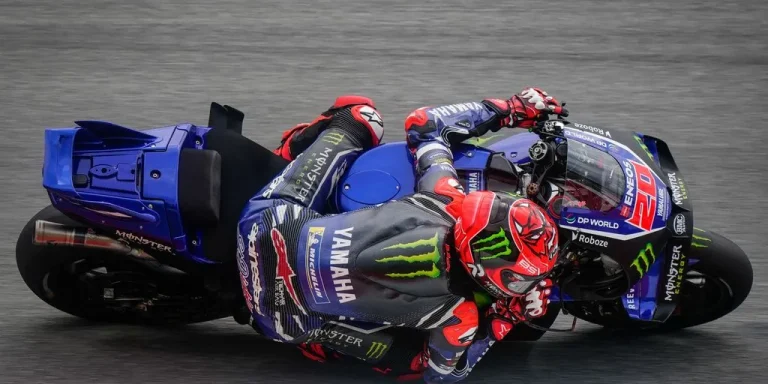
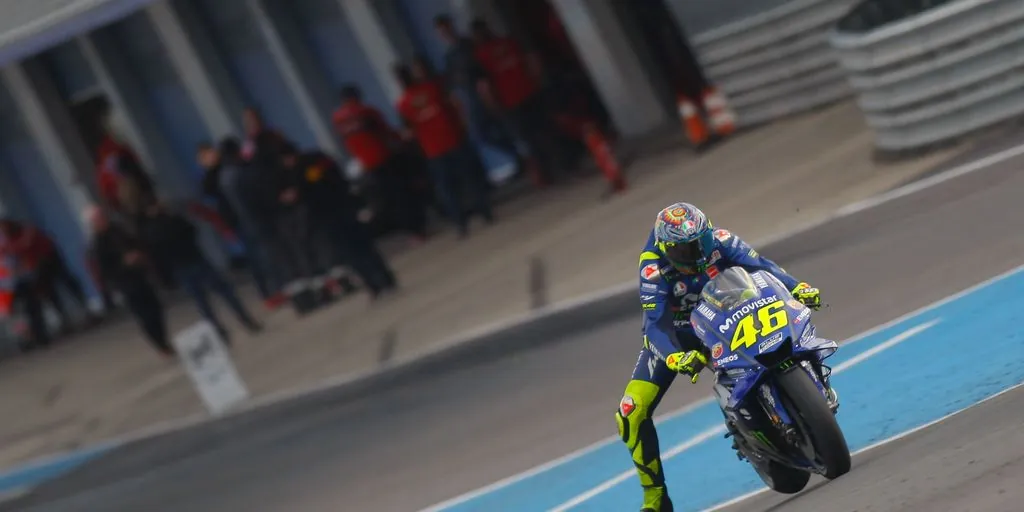
During high-speed approaches to corners, MotoGP riders can be observed letting their inside leg dangle out, often to the point where the boot touches the ground. This usually occurs when riders are braking in a relatively straight line, such as after a start-finish straight, or when braking in an upright position approaching the corner.
On more flowing or shorter corners, such as chicanes, riders tend not to use the technique willingly as there is less time and less stability to execute the move effectively.
Riders dangle either leg depending on corner direction and machine configuration. For left-hand corners, racers remove the left boot after operating the clutch lever to downshift gears. When riders dangle a right leg on a right-hand turn, they may be using the rear foot brake both before and after the dangle. Racers using traditional foot pedals tap the brake before kicking the leg out, returning the foot to the peg before tilting inward.
Others rely on handlebar-mounted levers or combined braking systems, allowing greater freedom when extending the right leg.
Lean Angle Boundaries and Straight-Line Braking
Cal Crutchlow, who completed 178 premier-class starts between 2011 and 2023, detailed the operational limits governing the move. Crutchlow explained that left corners allow extending the dangle until reaching approximately 54 degrees of lean angle, whereas right-hand turns demand earlier foot return to manipulate foot-operated brakes.
For straight-line braking, Crutchlow noted that because riders brake that last little bit to be able to decelerate in the smallest distance of time, they can be more on the limit.
Origins: The 2005 Spanish Grand Prix and Rossi's Influence
The earliest prominent demonstration occurred during the 2005 Spanish Grand Prix at Jerez. On the final lap heading into the concluding corner, Valentino Rossi launched an inside overtaking move against Sete Gibernau, kicking his inside left leg outward while braking extremely late. Gibernau ran wide on corner exit, allowing Rossi to seal victory by 8.631 seconds.
Rossi captured his fifth consecutive premier-class crown that season, cementing the maneuver into Grand Prix folklore as 'the Doctor's dangle'.
Rossi anecdotally remarked that he acted purely on instinct because the motion simply felt right. Rivals quickly recognized the visual marker and replicated it. The movement can be seen at every Grand Prix in MotoGP as well as in Moto2, Moto3, WorldSBK, and many other series, with even junior riders in the Red Bull MotoGP Rookies Cup doing it.
Alongside modern cornering techniques where riders often hang off the bike to the point where knees, elbows and even shoulders touch the ground, as explored in why MotoGP riders drag their elbows, leg dangling became an accepted component of contemporary racecraft.
Related posts
Center of Gravity and Physical Energy Expenditure
Several theories suggest why the widespread braking technique might be effective. Permitting the leg to hang naturally requires less muscular tension than anchoring boots firmly against footpegs under violent deceleration. Releasing the inside leg shifts overall center of gravity inward and downward. This altered mass distribution enables the motorcycle to stay upright longer before tipping in.
A more upright orientation maintains a broader tyre contact patch against the asphalt, directly boosting braking stability, friction, and stopping force.
Aerodynamic Drag and Psychological Defense
Aerodynamic resistance creates another tangible effect. On straights, when riders seek speed and maximum acceleration, they tuck in and make themselves as compact as possible to improve aerodynamics. In contrast, under braking, dangling a leg is said to increase air resistance as the rider uses the leg and body like a parachute. Airflow pushes the rider's torso backward, relieving immense G-force strain on forearm muscles.
Furthermore, the hanging limb generates a low anchor effect pulling downward. Psychologically, others claim the move may distract or block opponents as the rider seeks to defend or take a position during cornering.
Guintoli's Analysis of Weight Distribution and Equipment Wear
Former MotoGP rider and 2014 WorldSBK champion Sylvain Guintoli highlights how the posture alters load distribution. Extreme deceleration pitching creates massive forward weight transfer onto the handlebars. Dangling the inside leg shifts weight from front to rear, allowing riders to put more weight onto the seat and outside footpeg so they can be a lot more planted.
Guintoli views low aerodynamic resistance as a vital marginal gain in elite competition, maintaining that apart from grinding leather boots against abrasive tarmac, the technique presents no performance disadvantages.
Stature Disparities and Chassis Stability Risks
Crutchlow observed that body height changes how riders utilize the technique. At 170 centimeters tall, Crutchlow noted shorter competitors dangle their legs wider to compensate for shorter reach. Taller riders hold greater upper-body leverage, enabling them to clamp the fuel tank without locking their arms straight.
Crutchlow warned that putting a leg out can also upset the bike; if a rider cannot grip the tank with their knees when the bike starts moving, having the leg out can make instability worse, leaving a fine line to be able to keep the bike in a straight line without upsetting it.
Style Variations and Skepticism Among Champions
Despite wide adoption, the technique is not universally favored. Three-time MotoGP world champion Jorge Lorenzo deliberately shunned the dangling leg, maintaining extraordinary cornering speed with a remarkably smooth, compact riding style. Lorenzo's ability to maintain incredible corner speed without the move perhaps hints that the leg dangle may not be as provably beneficial as some claim.
Nevertheless, on machines that can travel at speeds in excess of 365 km/h (227 mph), as covered in how fast MotoGP bikes really are, most racers exploit every fractional advantage.
Practical Considerations for Track-Day Amateurs
For inexperienced riders, the best advice might be to proceed with caution, as a sudden shift in weight when trying the leg dangle for the first time could cause a crash. Sticking a boot out on public highways creates dangerous distractions and destabilizes handling where safety takes precedence over velocity. Even on closed circuits, sudden balance shifts can induce crashes.
Guintoli notes that while track-day riders can try dangling their leg, he does not think they will feel a difference unless they are really on the limit. Because the gains are really small and marginal, he advises amateur riders not to bother unless they are chasing a local track lap record, suggesting other techniques offer better initial improvements.